
Stop using arbitrary timelines to manage your home masonry projects and concrete curing time. Most property owners believe that concrete behaves exactly like mud or wood paint—assuming it simply needs to dry out before it can handle heavy traffic. This fundamental misunderstanding costs homeowners thousands of dollars in premature slab failures, surface cracks, and structural pitting every single year.
The baseline industry guideline suggests waiting four full weeks before exposing new pours to standard usage. However, while full structural cure is a long-tail chemical process that formally spans 28 days, your property elements do not actually require a completely completed chemical reaction to tolerate active operations. Instead, they must successfully cross a critical technical benchmark: 75% compressive strength. If you are automatically waiting an entire month to walk on a patio or park a vehicle on a fresh driveway, you are wasting valuable utility time. Maximizing your property assets means looking past traditional timelines and understanding how physical field variables dictate real-world concrete curing time.
If you are ready to stop guessing and start measuring, use our 7-Day Concrete Curing Simulator to calculate your project’s safety threshold based on your local forecast.
Hydration vs. Drying: The Chemistry of Concrete Curing Time
To fundamentally protect your structural masonry investments, you must discard the idea that concrete dries to get hard. Evaporation is actually the sworn enemy of a pristine pour.
Concrete gains its massive load-bearing capacity through a physical phenomenon known as hydration. When cement particles are exposed to water molecules, they don’t simply lose moisture; they undergo a molecular transformation. This exothermic chemical reaction creates complex, interlocking crystalline chains that lock the raw sand and aggregate together into an artificial stone matrix.
Cement Minerals + Water ── Hydration Reaction ──> Interlocking Crystalline Matrix + Heat Generated
If you accelerate the drying process by exposing a fresh pour to heavy wind, direct noon sunlight, or unmanaged ambient heat, the water evaporates before it can complete this chemical conversion. When evaporation outpaces hydration, the chemical reaction grinds to a permanent halt. The resulting slab will feel dry to the touch, but its internal architecture will be brittle, chalky, and structurally compromised.
Consequently, optimizing your residential concrete curing time is actually an active process of trapping moisture inside the slab rather than encouraging it to escape. Professional field techniques, such as applying liquid curing compounds, continuous misting, or laying down saturated burlap mats, are all intentionally engineered to artificially extend the hydration window so the structural core can hit its peak target performance.
Structural Milestones: The Real-World Timeline for Concrete Curing Time
Instead of treating the standard 28-day laboratory window as an absolute operational rule, residential project managers should look at structural performance milestones. Compressive strength development operates on a steep exponential curve rather than a linear trajectory.
| Curing Duration | Average Structural Strength Achieved | Safe Operational Application |
| 3 to 6 Hours | Less than 15% | Surface finishing, stamping, and edge pooling only. |
| 24 to 48 Hours | 40% to 50% | Light foot traffic, forms removal, and pet isolation. |
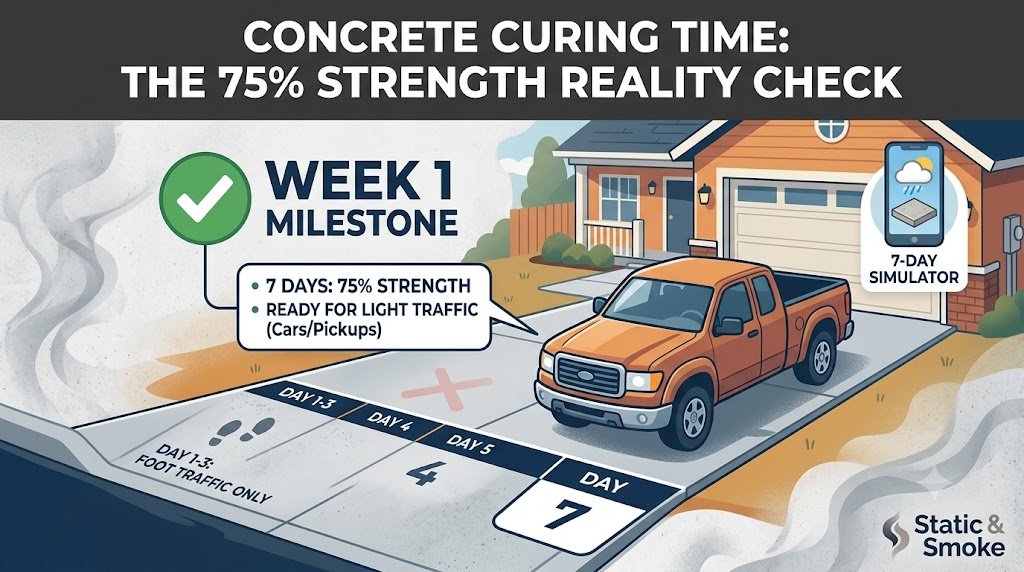
| 7 Days | 70% to 75% | Standard light vehicle parking, residential framing loads. |
| 28 Days | 99%+ | Maximum rated engineering capacity, commercial loads. |
Within the first 24 to 48 hours of initial placement, a properly managed pour develops enough structural integrity to support its own mass and survive light, distributed forces. This is the point where you can safely walk across the surface to inspect the finish, remove heavy perimeter wood forms, and let pets nearby.
However, the major milestone occurs at day seven. Under ideal conditions, a standard residential mix design will hit approximately 75% of its ultimate strength capacity by the end of its first week. This 75% threshold is the exact engineering benchmark required to safely backfill soil against retaining structures, begin structural light framing on top of footings, or store standard household building materials. By targeting this phase using precise concrete curing time field metrics, you can confidently return your property infrastructure to active service weeks ahead of legacy schedules without sacrificing surface durability.
Environmental Modifiers: Why Local Weather Alters the Math of Concrete Curing time
A standard chart cannot accurately calculate local field performance because chemical reactions are slaves to ambient atmospheric conditions. Your localized concrete curing time expands and contracts constantly based on three environmental forces:
Temperature Spikes and Freezes
The speed of cement hydration is directly proportional to internal mass temperature. When the thermometer climbs between 75°F and 90°F, hydration speeds up significantly, which dramatically compresses your early-stage concrete curing time.
However, this early velocity comes with a catch: rapid heat generation can create internal thermal stresses that cause spiderweb surface cracking. On the flip side, when temperatures drop below 50°F, the chemical reaction slows down dramatically. If the core drops below 40°F, the strength-gain process stalls completely. If a fresh pour freezes before hitting a minimum threshold of 500 PSI, the expanding internal ice crystals will permanently fracture the matrix, ruining the slab.
Relative Humidity Levels
High ambient humidity is a massive asset for residential property projects. When the surrounding air is saturated with water vapor, the evaporation rate from the surface slows down, allowing the slab to retain its necessary hydration water naturally. Conversely, dry desert air or low-humidity regions will pull moisture right out of the top layer, requiring instant intervention via continuous wet curing or heavy plastic sheeting.
Maximizing Durability with Data Over Myths for Concrete Curing Time
Relying on arbitrary rules of thumb is a surefire way to compromise your home’s hardscaping. If you subject a fresh driveway slab to heavy vehicular weight before it crosses the 75% strength threshold for concrete curing time, you run a high risk of causing surface spalling—the progressive flaking and pitting of the top aggregate layer. This type of damage is a structural failure that cannot be washed away or easily repaired; it requires a costly surface grind or a total tear-out.
Premature Heavy Load + Sub-75% Compressive Strength = Internal Shearing / Surface Spalling
By prioritizing technical concrete curing time metrics over legacy myths, you can run a much cleaner, more efficient job site. Tracking your local pour conditions helps you pinpoint the exact sweet spot where your masonry is strong enough to handle real-world challenges, letting you keep your project moving forward without taking unnecessary risks. Ultimately, managing your project using concrete maturity principles rather than an arbitrary calendar ensures that your driveways, patios, and foundations remain crack-free, highly durable, and structurally sound for decades to come.
Interactive 7-Day Concrete Curing Time Simulator
Before checking the math on your structural mix design, you must map out your local atmospheric variables. Ambient temperature and moisture retention strategies dictate exactly how quickly cement particles undergo chemical hydration. Use the 7-Day Concrete Curing Simulator below to plot your local weather forecast, calculate your project limits, and determine if your slab will safely cross the 75% strength threshold or succumb to environmental stress cracking.
🚧 7-Day Concrete Curing Simulator
Map your local 7-day weather forecast to predict if your slab will hit the critical 75% strength threshold or crack under environmental stress.
🛠️ What should we break down next? let us know your suggestions in the comments—or drop us a line directly through our Contact Page!