
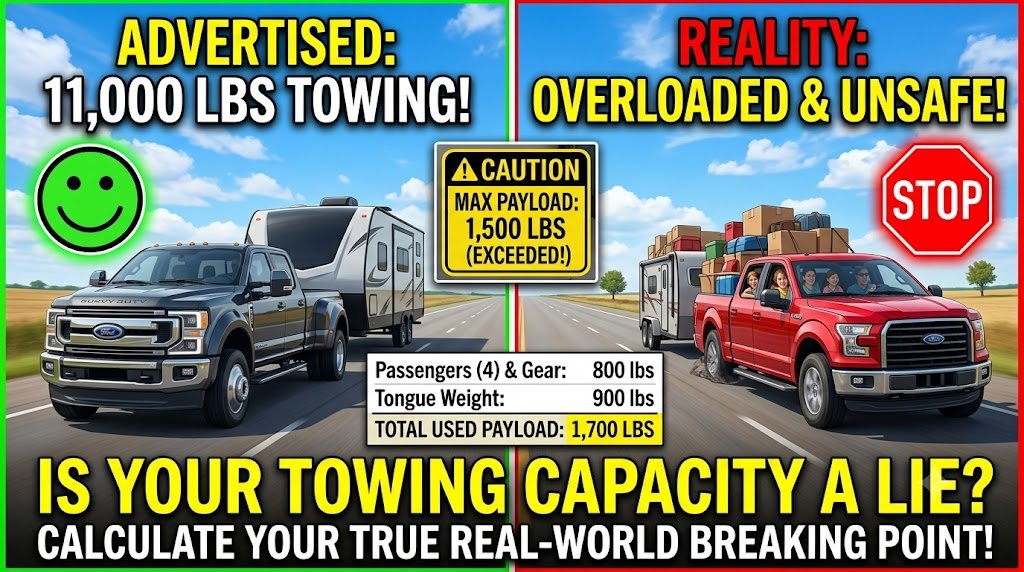
Looking only at an advertised maximum truck towing capacity does not tell the full story of a particular truck and trailer setup. Manufacturer tow ratings describe limits under specified vehicle configurations and test conditions. In everyday use, the available capacity of a loaded setup also depends on other applicable ratings, including payload capacity, GVWR, and GCWR.
A single towing number cannot describe every combination of passengers, cargo, hitch equipment, and trailer load. Understanding how these ratings relate to one another provides a more useful way to evaluate the numbers before you tow.
Click HERE to skip to the Truck Towing Capacity and Payload Calculator.
What Is Truck Towing Capacity?
Truck towing capacity is one of several operating limits used to describe how much trailer weight a vehicle is rated to pull under conditions specified by the manufacturer. These limits are based on the vehicle’s design, equipment, and configuration. How a loaded setup compares to a vehicle’s rated capacity depends on more than the trailer’s total weight alone. Understanding your truck towing capacity starts with looking at how manufacturer ratings interact under real-world conditions.
A few related terms come into play when looking at real-world towing setups:
- Gross Vehicle Weight Rating (GVWR): The maximum total weight of the vehicle itself, as specified by the manufacturer, including passengers, bed cargo, fuel, fluids, accessories, and the downward weight applied through a trailer hitch.
- Payload Capacity: The amount of weight the particular truck is rated to carry in addition to its unloaded condition, within its specified GVWR. Depending on the vehicle and towing configuration, this can include passengers, cargo, accessories, and trailer tongue or pin weight carried by the truck.
- Gross Combined Weight Rating (GCWR): The maximum combined weight of the fully loaded truck and fully loaded trailer together, as rated by the manufacturer.
- Tongue Weight or Pin Weight: The downward force a trailer’s tongue or pin applies to the hitch or bed of the towing vehicle.
- Weight Distribution Hitch (WDH): A hitch assembly designed to distribute a trailer’s tongue weight across the axles of both the towing vehicle and the trailer.
Does Payload Capacity Affect Truck Towing Capacity?
It can. A truck’s advertised maximum towing capacity and its available payload are separate considerations. Passengers, cargo, accessories, and hitch equipment add weight to the truck, while trailer tongue or pin weight can also contribute to the load carried by the towing vehicle.
That means a truck may have an advertised towing rating that is higher than what a particular loaded configuration can usefully accommodate once the other applicable vehicle and trailer ratings are considered.
What Might Be Happening
An advertised maximum tow rating assumes a vehicle is set up under specific manufacturer conditions. In practical use, several variables can affect how much truck towing capacity remains available within the applicable ratings:
- Passenger and Cab Weight: Weight added inside the cab, including drivers, passengers, and personal items, can count against available payload capacity affecting the truck towing capacity.
- Cargo and Aftermarket Accessories: Items carried in the truck bed, along with aftermarket additions such as heavy bumpers, winches, or bed covers, can reduce remaining payload.
- Weight Distribution Hitch (WDH): A hitch system that uses spring bars or similar components to redistribute some of the load created by trailer tongue weight, helping transfer load toward the tow vehicle’s front axle and the trailer.
- Trailer Cargo and Liquid Load: Water, propane, batteries, gear, and supplies added to a trailer can increase its total weight and change its tongue weight.
- Distribution of Weight: How cargo is loaded inside a trailer can change the proportion of weight resting on the hitch compared to the trailer’s axles.
Why Towing and Payload Ratings Exist
Manufacturer weight ratings define limits for vehicle and trailer systems under specified operating conditions. These ratings describe different limits for different parts of the towing system. Looking at them together helps explain how the truck, trailer, and combined setup are being evaluated.
- Payload and Tongue Weight Connection: Trailer tongue weight rests on the rear of the truck. Because payload capacity covers weight added to the truck, tongue weight can count against available payload.
- Combined Weight Constraints: Even if a trailer stays below your advertised truck towing capacity, loaded passenger and bed weight can still bring the setup close to its overall combined limits.
- Braking and Cooling Considerations: Vehicle weight and towing conditions can affect braking, drivetrain loads, and cooling demands. Manufacturer ratings and towing requirements are established using specified test conditions and vehicle configurations, but the individual ratings should not be treated as a complete substitute for the manufacturer’s towing instructions.
What the Driver Can Safely Observe
A driver can gather useful reference information through safe, visual, non-invasive observation:
- Check the Vehicle Door Jamb Sticker: The driver’s-side door-jamb tire and loading information label provides vehicle-specific weight information and, depending on the vehicle, may state a maximum combined occupant and cargo load.
- Review the Trailer Data Plate: The manufacturer label on the trailer lists its Gross Vehicle Weight Rating rather than an empty “dry weight” figure. This can serve as a baseline reference, but it does not confirm how the trailer is actually loaded at a given time.
- Inspect Visible Equipment: A visual check of the hitch receiver, safety chains, hitch pin, and weight distribution hardware for wear, rust, or loose fasteners can be a useful clue, but it does not confirm the mechanical condition of internal components.
- Examine Tire Information: Sidewall markings on truck and trailer tires show load range ratings, and door or trailer placards show recommended pressures. Comparing these is a helpful reference, but it does not confirm actual load distribution across the axles.
Reviewing labels and visually inspecting equipment can offer useful context, but these observations alone do not confirm actual axle weights, total loaded weight, or full compliance with applicable ratings.
What Requires Professional Judgment
Confirming exact axle weights, total tongue weight, and combined gross weight can require specialized measurement equipment beyond what a visual check can provide. Evaluating or adjusting more complex mechanical and hitch-related components also involves technical judgment and procedures that fall outside routine visual observation.
When weight figures are uncertain, equipment shows signs of wear, or visual observations raise questions about a loaded setup, a qualified professional can review the configuration against the applicable manufacturer ratings. If issues persist or safety concerns arise, contact a qualified professional to evaluate your specific setup.
Truck Towing Capacity and Payload Calculator
The calculator below is a reference tool for comparing your vehicle’s manufacturer-specified ratings against the loads you plan to carry or tow. Start by entering the ratings listed on your vehicle’s door jamb sticker and manufacturer documentation. Then enter your passenger, cargo, hitch, and trailer information to see how those figures compare to the ratings you entered.
Pro-Tip: If you’ve added aftermarket accessories such as a winch, steel bumper, or bed canopy, those items can count against your payload and affect how much truck towing capacity remains available. Entering estimated accessory weights into the calculator helps clarify how much truck towing capacity and payload remain available for your trip.”
💬 What does your rig look like? Share your truck and trailer setup in the comments below. If you’d like to look further into how towing ratings are established, you can review the SAE J2807 towing standard directly.
🛠️ What should we cover next? Let us know in the comments, or reach out through our Contact Page.
1 thought on “5 Essential Truck Towing Capacity and Payload Limits You Should Check Before You Tow”