
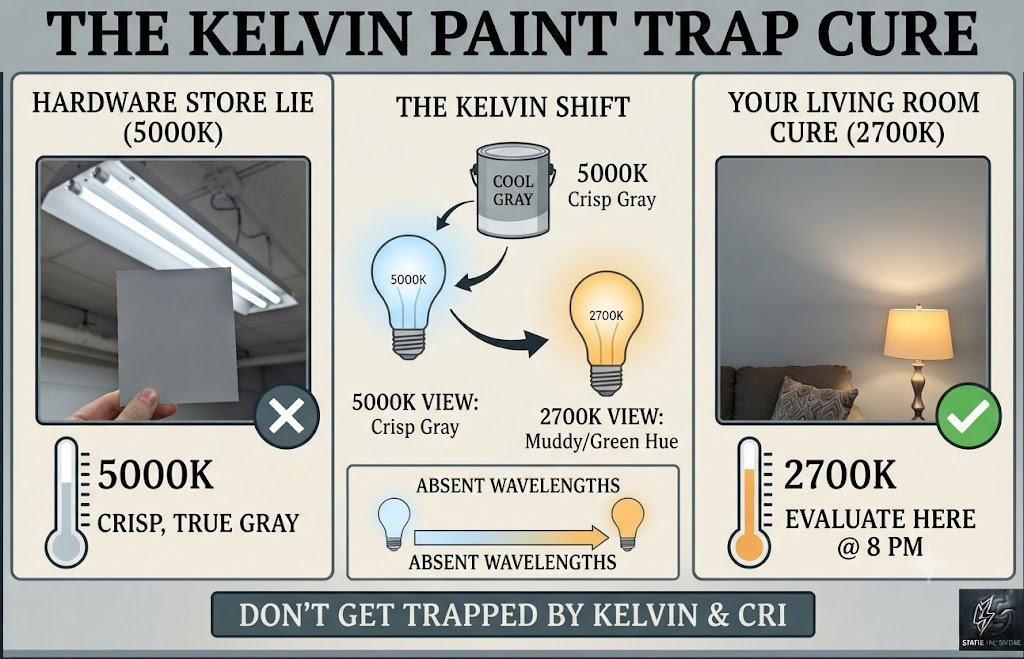
Why does my paint look different on the wall? Paint colors look different on the wall because of a hidden Kelvin paint trap that shifts pigment based on your room’s artificial lighting. A cool gray paint will appear crisp under 5000K daylight bulbs, but will look muddy, warm, or slightly green under traditional 2700K soft white incandescent bulbs. To get an accurate color read, you must view the paint sample under the exact Light Reflectance Value (LRV) and bulb temperature that will be used in that specific room, effectively bypassing the Kelvin paint trap before you commit to a color.
The Hardware Store Lie: Why You Fall for the Kelvin Paint Trap
You spend hours agonizing over swatches. You finally drop $150 on premium interior paint. You tape the trim, roll the walls, and step back to admire your work in the afternoon sun. It looks perfect. But then the sun goes down, you flip on your living room lamps, and suddenly your elegant modern gray looks like a bruised, muddy blue. You didn’t mix the paint wrong, and your eyes aren’t deceiving you; you are simply the latest victim of the Kelvin paint trap.
Big-box home improvement stores illuminate their paint aisles with massive industrial fluorescent arrays. These commercial lights operate between 4000K and 5000K, blasting swatches with harsh, cool-toned daylight. Meanwhile, most residential living rooms utilize soft white bulbs around 2700K. You essentially picked a color in a clinical laboratory and brought it home to a cave, ignoring how the Kelvin paint trap would distort the final result.
Understanding the Kelvin Paint Trap: The Physics of Pigment
When homeowners desperately search for answers regarding why paint looks different, they are usually met with generic advice. That ignores the fundamental physics of how the eye interprets pigment. If you choose a gray paint with blue undertones, it requires blue-spectrum light to reflect that blue back. If you use a 2700K bulb, which is skewed toward yellow, the paint cannot reflect blue. By understanding the Kelvin paint trap, you stop blaming the paint and start managing the light.
Many DIYers fail to account for this Kelvin paint trap because they test their colors in daylight, effectively ignoring the light source they will be living with for 90% of their time in that room.
Beat the Kelvin Paint Trap: Interactive Diagnostic Tool
Before you spend another weekend repainting, test your understanding of how artificial light manipulates pigment. Use our diagnostic tool below to see the Kelvin paint trap in action.
Challenge: Match the Light
Adjust the slider to match the Target Swatch.
Target
Your Wall
4000K
LRV and CRI: The Advanced Paint Math
The structural answer to why paint shifts comes down to Light Reflectance Value (LRV) and Color Rendering Index (CRI). A high-LRV wall will heavily reflect whatever temperature your light bulbs emit, which often exacerbates the Kelvin paint trap. Always look for bulbs with a CRI of 90 or higher to ensure you aren't washing out your pigment.
The 3-Step Formula to Never Buy the Wrong Paint Again
Next time a neighbor asks why their wall color changed, hand them this process to help them avoid the Kelvin paint trap entirely:
- Check the Hardware: Before buying paint, check your bulb for the Kelvin rating.
- Prime a Test Square: Paint a 2-foot by 2-foot square of white primer first; otherwise, the old wall color will mask the true effect.
- The 8 PM Test: Evaluate your dried swatch at 8 PM under your home's actual lighting.
The secret? Lighting is a variable. If you treat your selection like a scientific experiment—controlling for Kelvin and accounting for the 8 PM shift—you will achieve a finish others miss. Don't just pick a color; engineer the environment.
🛠️ What should we break down next? let us know your suggestions in the comments—or drop us a line directly through our Contact Page!