
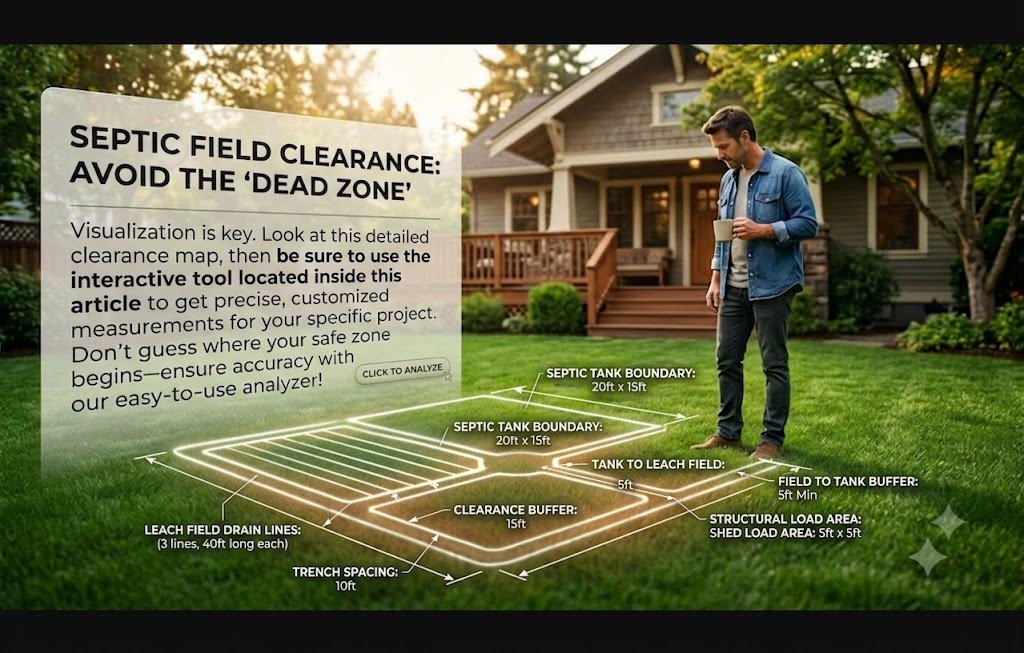
There is a certain kind of magic in shaping your own patch of earth. We’ve all been there: staring out the back window, coffee in hand, visualizing exactly where that new storage shed will sit, or where the deck will wrap around a new hot tub. Your backyard is a canvas waiting for your next project.
But beneath that canvas lies a vital, invisible ecosystem: your septic system. When it comes to safely executing those backyard projects, understanding proper septic leach field clearance is the most critical step you will take.
When you start digging into where you can actually build, the inspiration often hits a brick wall. Most online searches lead to a frustrating data vacuum of generic “check local codes” advice or unreadable 80-page municipal sewer PDFs. You just want to know how close you can put your shed to the yard’s “dead zone” without causing a disaster. We hear you, and we’ve translated the engineering into plain English.
👇 Skip the reading and jump straight to the Septic Field Clearance & Compaction Matrix
What is the Minimum Setback for Septic Leach Field Clearance?
To prevent structural soil compaction and catastrophic pipe failure, a standard household shed or shallow-foundation structure must maintain a minimum horizontal setback of 10 feet from any edge of a septic tank, and 15 feet from the outermost disposal trench lines of a septic leach field clearance zone. For heavy or deep-footing structures—such as above-ground pools, heavy outbuildings, or concrete slabs—this septic leach field clearance buffer must scale to a minimum of 25 feet.
Why Septic Leach Field Clearance Matters: Soil Compaction and Breathability
It is tempting to look at a flat, grassy drain field and see wasted space. But that soil is actively working. A leach field is not just a dump site; it is a living, breathing mechanism.
When you place a structural load—even a “light” 3,500 lb. riding mower shed—too close to these underground trenches, two things happen:
- Soil Compaction: The weight presses the air out of the soil. The microbes that treat your wastewater rely on oxygen to survive. If the soil is compacted, the oxygen is choked off, the biomat thickens, and the system suffocates.
- Shear Stress & Crushing: The perforated PVC or corrugated pipes in your leach field are shallow, usually only 18 to 36 inches below the surface. They are not engineered to handle external gradient pressure. A heavy structure nearby creates a downward cone of pressure that can easily crack or crush aging pipes.
The Autumn Urgency Septic Leach Field Clearance: Timing Your Earthworks
We see a massive surge in drainage and septic leach field clearance questions between September and November. As the leaves start to turn, there is a collective, frantic push to finish backyard grading, tree planting, and structural projects before the ground freezes solid.
If you are rushing to beat the frost, do not let urgency override your boundaries. Pouring a foundation or compacting soil right before winter means the ground will freeze in that compacted state, drastically reducing your septic leach field clearance capacity just as the wet season begins.
The Soil Load Setback Analyzer
Because nobody should have to guess where the safe zone begins, we built a tool to do the heavy lifting for you.
Before you break ground, use our septic leach field clearance matrix below. Simply input your planned structure type, its estimated total weight, and the target septic component. The matrix will calculate your structural soil shear stress and tell you exactly how far back you need to push your project to stay out of the danger zone.
🚜 Septic Field Clearance & Compaction Matrix
SOIL BOUNDARY & STRUCTURAL LOAD CHECKER
1. Planned Structure
2. Clearance Setback
Frequently Asked Questions (FAQ)
Can I drive heavy machinery over my septic leach field during construction?
Absolutely not. Even a single pass from a backhoe, loaded skid steer, or materials delivery truck can instantly crush the shallow PVC pipes and catastrophically compact the soil. If you are building a structure safely outside the setback zone, ensure your contractor tapes off the entire leach field with high-visibility fencing as a strict "no-drive" area before any work begins.
What if I want to plant trees to hide the new shed?
Tree roots are just as destructive as structural weight. They aggressively seek out the nutrient-rich water in your drain field, eventually infiltrating and clogging the perforated pipes. As a baseline, plant trees at least as far away as their estimated mature canopy will reach. For water-loving species with aggressive root systems, keep them a minimum of 50 feet away from the septic lines.
How do I verify my specific county's septic regulations?
While our clearance matrix uses standard engineering and soil compaction baselines, every local health department has its own quirks depending on local soil types and water tables. For instance, out here in Washington State, we see incredibly strict enforcement from local health jurisdictions specifically concerning seasonal high groundwater and septic leach field clearance setbacks. Always cross-reference your final plans with your county health department.
If you want a fantastic, plain-English deep dive into how these systems function and how to protect your investment, we highly recommend reading through the EPA's SepticSmart Homeowners Guide.
🛠️ What should we break down next? let us know your suggestions in the comments—or drop us a line directly through our Contact Page!