
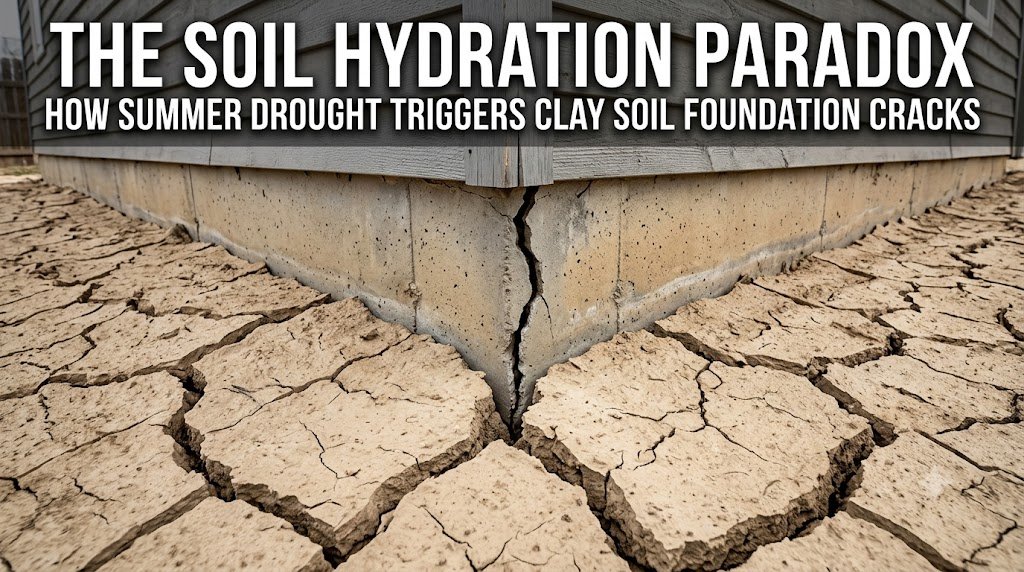
The earth beneath your home isThe Soil Hydration Paradox: How Summer Drought Triggers Clay Soil Foundation Cracks
The earth beneath your home is breathing, but right now, the shifting ground that leads to clay soil foundation cracks is silently suffocating.
During the peak of July, when the lawn turns the color of cardboard and the air smells like baked dust, a quiet trauma is occurring right under your feet. Most homeowners look up at the scorching sun and worry about their hydrangeas or their cooling bills. They don’t look down. They don’t see the perimeter of their home slowly decoupling from the very earth meant to stabilize it. It is the great seasonal deception of homeownership: the structural damage you discover during a freezing winter blowout was actually born on a blistering summer afternoon.
The Hidden Mechanics of Summer Desiccation
When summer heat bakes the earth, highly expansive clay soils—specifically types rich in minerals like montmorillonite—undergo extreme volume loss. As moisture evaporates, the clay molecules shrink tightly together, causing the ground to pull away from your concrete slab or basement walls.
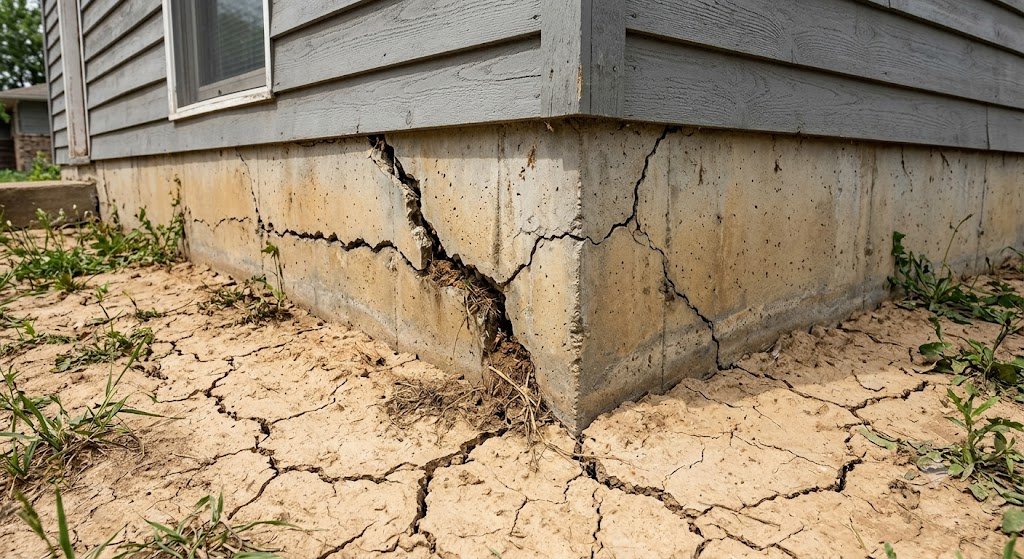
You’ve likely walked your property and noticed those deep, ominous fissures running parallel to your concrete. These aren’t just cosmetic surface blemishes; they are deep structural highway systems. By allowing the soil to contract and pull away, a physical void is created around your home’s footprint, leaving the concrete completely unsupported from the side and exposed to what comes next. According to geological data tracked by the United States Geological Survey
, expansive soils hold shrink-swell properties that cost billions in structural damages annually. If left unmanaged, this extreme summer shrinkage sets the exact geological stage for severe clay soil foundation cracks to split your property open later in the year.
Why Summer Drought Triggers Structural Shifting
The trap springs 3 to 6 months later when the seasons shift. When heavy late-autumn and winter rains finally arrive, water doesn’t gently saturate the lawn from the top down. Instead, gravity takes the path of least resistance: millions of gallons of seasonal runoff pour directly into those deep summer fissures.
[Summer Drought] ---> Clay Shrinks & Pulls Away ---> Deep Fissures Open
                                                             |
[Winter Heavy Rains] ---> Water Pours Directly into Fissures <---
                                                             |
[Hydrostructural Swell] ---> 5,500 psf Hydrostatic Pressure ---> FOUNDATION CRACKS
This sudden influx causes a hydrostructural paradox. The deep, desiccated clay layers absorb the water rapidly and swell with immense force. Because the water has bypassed the upper topsoil and gathered deep against the vertical subterranean walls of your home, the expanding clay has nowhere to go but inward. This rapid volume change generates devastating lateral load forces, frequently causing the sudden clay soil foundation cracks that standard residential masonry zones cannot withstand.
The Hard Math Behind Hydrostatic Pressure
To understand how these seasonal shifts cause destructive clay soil foundation cracks, you have to look at the uncompromised load physics.
Under normal, evenly moist conditions, soil exerts a manageable lateral pressure against a basement wall—typically around 40 to 60 pounds per square foot (psf) per foot of depth. However, when expansive clay transitions from a state of severe summer drought to total winter saturation, its swelling pressure skyrockets exponentially.
- Active Swelling Pressure: Saturated expansive clay can exert an upward and inward lateral force of up to 5,500 pounds per square foot (psf) against a concrete wall.
- The Structural Breaking Point: Standard unreinforced 8-inch concrete block walls are structurally rated to withstand only a fraction of that pressure before bowing. When the lateral load exceeds the tensile strength of the concrete, the wall snaps. The resulting horizontal fractures, shifting blocks, and immediate water intrusion pathways are classic symptoms of clay soil foundation cracks left to fight geology alone.
Preventing Damage: The Managed Hydration Strategy
You cannot change the geology of the land your house was built on, but you can disrupt the cycle of desiccation and saturation. The goal is simple: maintain moisture equilibrium so you never have to deal with structural clay soil foundation cracks in the first place.
1. Implement Controlled Perimeter Hydration
The most effective way to prevent the underlying shifting that causes clay soil foundation cracks is to keep the ground from pulling away in July. Running a dedicated soaker hose 18 inches away from your foundation wall during peak summer months keeps the deep clay layers consistently hydrated, preventing the structural voids from opening.
2. Manage Winter Runoff Displacement
When winter hits, ensure your downspouts are discharging water at least 5 to 10 feet away from the home’s perimeter. If your gutters dump rainwater directly into the zones where summer cracks opened, you are actively accelerating the hydrostatic pressure spike that fractures the concrete and creates costly clay soil foundation cracks.
Protecting Your Largest Asset
A home is more than an assembly of wood, nails, and poured concrete—it is a sanctuary, a stabilizing anchor for your life. Watching a basement wall bow or discovering a jagged line tearing through your crawlspace can feel like a violation of that safety.
But remember: concrete doesn’t just break on its own. It breaks because it was forced to fight an uneven battle against shifting geology. By understanding the soil hydration paradox, identifying the deep fissures before the winter rains come, and keeping the ground stabilized, you can step off the expensive corporate repair carousel and protect your structure with true data-backed utility.
To truly protect your structure, you have to look beyond what is visible to the naked eye. You have to understand the invisible load mechanics working against your concrete right now. Geology isn’t a static backdrop; it is a dynamic, shifting force determined entirely by the weather patterns of the current season.
Use the interactive calculator below to see exactly how your local soil type reacts when the intense bake of a summer drought suddenly gives way to the heavy saturation of a winter deluge. Slide the controls to map out your property‘s real-time risk profile and discover the exact moment your foundation enters the danger zone
🏠 Soil Moisture & Foundation Stress Simulator
🛠️ What should we break down next? let us know your suggestions in the comments—or drop us a line directly through our Contact Page!