
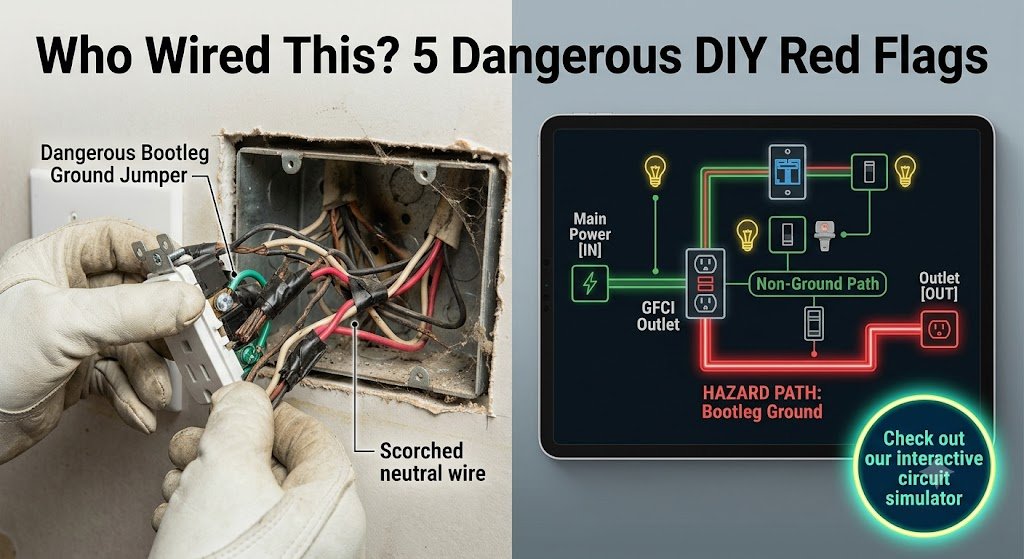
You buy an older house with good bones, solid trim, and a yard that stretches just far enough. It feels like home. But the moment you decide to swap out an ugly, almond-colored outlet cover from 1978 for a clean white faceplate, the illusion cracks. You pull the receptacle out of the wall, freeze, and realize you are face-to-face with dangerous DIY electrical wiring.
Jammed inside the junction box is a chaotic, bird’s-nest tangle of electrical tape, three different wire jacket colors spliced together without wire nuts, and a faint smell of scorched plastic.
Your stomach drops. You realize the previous owner was a self-certified weekend warrior who thought electrical codes were merely “suggestions.”
Uncovering a previous owner’s electrical mistakes is a rite of passage for the modern homeowner, but it is also an immediate hazard. When an amateur tinkers behind the drywall, they do not just leave an eyesore—they leave a thermal time bomb. If you want to protect your property and your sanity, you need to know how to identify dangerous DIY wiring before you plug in a high-amperage summer air conditioner or a winter space heater.
The Golden Rule: Capturing the Dangerous DIY Electrical Wiring
Before you call an emergency electrician or start ripping out copper, let’s establish the exact parameters of what constitutes an unpermitted hazard.
How do you identify iil dangerous DIY electrical wiring? The most common indicators of hazardous unpermitted electrical wiring include reversed hot and neutral polarities at the outlet terminals, open junction boxes hidden behind drywall without access covers, ungrounded two-prong circuits illegally converted to three-prong receptacles, and over-loaded neutral lines sharing multiple branch circuits. These violations bypass basic thermal safety parameters, heavily elevating your immediate structural fire risk.
🚧 Play Out-Wire The Previous Owner
Think you can navigate the terrifying maze of unpermitted residential modifications? Test your luck against the ghost of the previous homeowner’s “handyman” logic and dangerous DIY electrical wiring. Click the circuit terminals below to safely wire the outlet—but trace carefully. If you hit a bootleg ground or a hidden splice, you’ll trip the main panel breaker.
Electrical Safety Challenge
Navigate from the Main Power to the Outlet without hitting a hazard. Trace your path tile-by-tile.
Anatomy of an Unpermitted Disaster: The Big Four Mistakes
When amateurs mess with residential electrical systems, they tend to make the exact same programmatic errors. They lack the specialized tools, the patience, and the fundamental understanding of current return paths. Here is how to map out and identify dangerous DIY electrical wiring in your own home.
1. The Reversed Polarity Outlet Risk
Electricity is cyclical. It flows out along the hot wire (usually black) to power your appliance, and returns along the neutral wire (usually white) to complete the loop safely. In a standard outlet, the hot wire attaches to the brass screws, and the neutral wire attaches to the silver screws.
When a previous owner mixes these up, they create a severe reversed polarity outlet risk. The appliance will still turn on and function normally because AC current flows regardless of direction. However, the internal switching mechanics of items like lamps or toasters remain energized even when turned “off.” If you touch the metal casing of an appliance plugged into a reversed circuit, your body can accidentally become the alternative path to the ground.
2. Hidden Unpermitted Junction Boxes
According to the National Electrical Code (NEC), every single wire splice, wire nut connection, or branch circuit division must take place inside an approved electrical box, and that box must remain permanently accessible.
Amateurs hate running new lines. Instead, when they want to add a light fixture or move an outlet, they cut an existing wire inside the attic, crawlspace, or wall cavity, twist a new wire into it, wrap it in cheap vinyl tape, and bury it behind fresh sheetrock resulting in dangerous DIY electrical wiring. These hidden unpermitted junction boxes are major structural vulnerabilities. If a wire connection loosens over time due to thermal expansion, it creates an electric arc. Because the splice is buried directly against paper-backed drywall insulation or wooden studs, it can ignite an attic fire completely undetected until it breaks through the ceiling grid.
3. The Classic “Bootleg Ground” Trick
If your home was built before the mid-1960s, it likely utilizes older two-conductor systems without a dedicated bare copper grounding wire. When home flippers or lazy homeowners want to pass a real estate inspection or plug in three-prong computers, they use a dangerous DIY electrical wiring technique called a bootleg ground.
They pull out the old two-prong outlet, install a modern three-prong receptacle, and run a small sacrificial jumper wire directly from the silver neutral terminal screw straight over to the green grounding screw. If an inspector plugs a cheap three-light circuit tester into the outlet, the device lights up green, signaling a perfectly grounded outlet.
But it’s a lie. If the main neutral wire ever breaks or shakes loose upstream in the panel circuit, the full return voltage is automatically redirected down that jumper wire straight onto the metal chassis of your plugged-in electronics.
4. Over-Fusing (The Wrong Breaker Size)
This is perhaps the most critical dangerous DIY electrical wiring mistakes. A standard residential circuit utilizing 14-gauge copper wire is structurally rated to handle a maximum load of 15 Amps. If a previous owner kept tripping the 15A breaker because they were running a table saw and an air compressor at the same time, their “fix” was often to go to the hardware store, buy a 20-Amp breaker, and slap it into the main panel slot.
This is a massive violation of thermal physics. The thicker 20A breaker allows more current to pass down wires that are physically too thin to dissipate the heat. Long before the breaker ever senses a danger and trips, the insulation surrounding the hidden 14-gauge copper lines inside your wall cavities will melt down entirely, turning the bare wires red-hot.
The Homeowner Checklist: How to Audit Your Walls
You don’t need to strip your house down to the raw framing studs to audit your system. You can identify dangerous DIY electrical wiring methodically by tracking structural clues throughout your living spaces:
- The Warm-to-the-Touch Test: Walk your house during peak summer load hours. Physically place your hand over light switches and outlet plates. If a wall plate feels distinctly warm, you have an overloaded branch loop or a high-resistance loose connection generating heat inside the box.
- The Flickering Phantom: If your overhead lights dim or flicker specifically when a heavy appliance (like a refrigerator or microwave) kicks on, your system is suffering from voltage drops caused by poor line distribution or shared neutral feeds.
- The Odd Man Out: Look for non-matching switches, outlets mounted completely crookedly, or boxes attached to studs using standard drywall screws instead of specialized electrical nails or machine fasteners. If the exterior aesthetics look sloppy, the hidden splices behind them are guaranteed to match.
Taking Structural Control
If your residential diagnostic audit uncovers a nest of bad wiring or any other dangerous DIY electrical wiring, do not panic, and do not simply slap the outlet cover back on and pretend you didn’t see it. Step one is locating your main service panel, identifying the corresponding branch circuit breaker, and shutting it off entirely.
If you plan to remediate minor issues yourself—such as replacing a ungrounded outlet with a localized GFCI receptacle (which is a code-compliant way to protect a two-wire circuit)—always verify the line with a non-contact voltage tester before touching bare terminals. If you find multiple hidden unpermitted junction boxes or scorched wiring inside your panels, call a licensed professional. Your home is your primary financial asset; do not let a previous owner’s cheap shortcut compromise your family’s safety.
🛠️ What should we break down next? Let us know your suggestions in the comments—or drop us a line directly through our Contact Page!