
Quick Navigation
If you’re hearing water hammer noises meaning your pipes are actively banging right now and you need an immediate diagnostic breakdown to stop a catastrophic leak, use our interactive jump link to navigate down to our custom engineering interface to calculate your exact system risk.
You’re sitting on the couch at 10:00 PM when the dishwasher finishes its wash cycle. Suddenly, a violent, metallic THWACK rattles the wall studs behind the kitchen counter—sounding like someone swung a three-pound sledgehammer directly into your framing. That isn’t just an annoying house noise, and it isn’t “air in the lines.” It is the physical sound of an explosive hydraulic shockwave violently flexing your copper solder joints and tearing your pipe straps out of the drywall.
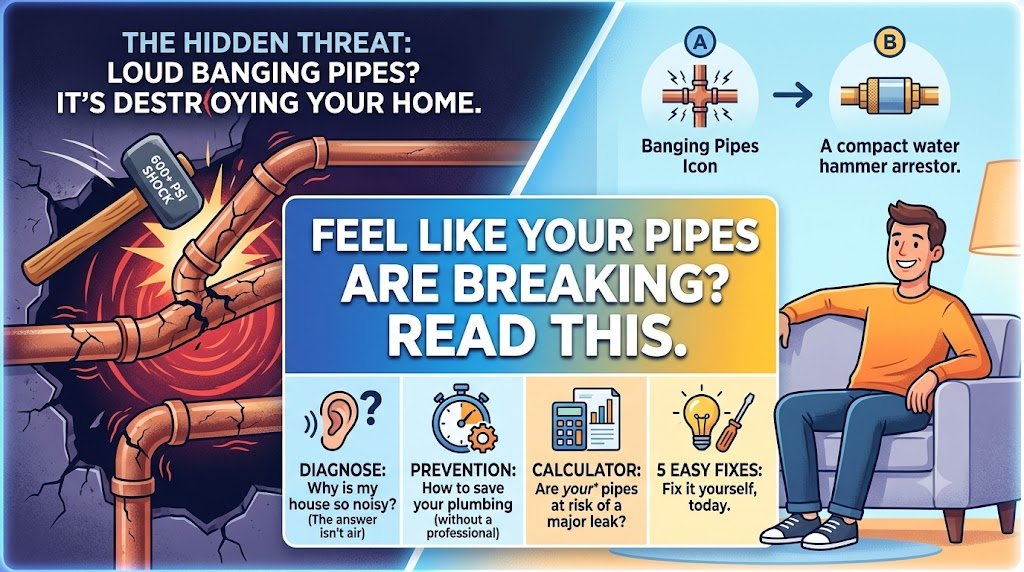
What causes water hammer in house pipes? Water hammer occurs when the flow of water is abruptly stopped by a fast-closing valve (such as in washing machines, dishwashers, or modern faucets). The sudden stoppage instantly converts the kinetic energy of the moving water into a high-pressure shockwave—often exceeding 600 PSI—which reverberates back through the plumbing system, causing pipes to violently vibrate against wall framing. This violent water hammer phenomenon is not just an annoying household noise; it is a progressive mechanical assault on your residential infrastructure. Every single time a modern electronic solenoid valve snaps shut, the unseen water hammer shockwave deforms copper walls, expands solder joints, and forces threaded fittings closer to their ultimate material failure limits.
The Physics of Fluid Momentum: Why Solenoids Create Water Hammer and Are Pipe Killers
To understand why this happens, you have to look at how modern appliances differ from older fixtures. When you turn off a traditional quarter-turn sink faucet by hand, your muscles take a second or two to shut down the flow. That gradual slowdown gives the moving water time to bleed its kinetic momentum safely back into the supply main. An electronic solenoid valve—the kind inside your washing machine, ice maker, or modern dishwasher—doesn’t operate on human time. When the control board tells it to close, a powerful electromagnetic spring snaps the internal gate shut in under 30 milliseconds.
When you freeze a moving mass of fluid that fast, the fluid dynamics get brutal. The formula for the theoretical dynamic shock magnitude shows that dynamic shock is directly tied to fluid density, velocity, and the speed of the acoustic wave in the medium. When that velocity drops to zero instantly, localized pressure surges to four or five times your static baseline. Your copper lines, which were built to handle a steady 50 to 70 PSI, are suddenly taking repeated 300 to 600 PSI punches. Over thousands of washing machine cycles, that relentless over-pressurization leads to material fatigue, weakening the brass fittings and slowly expanding the solder seams until a joint gives out entirely.
Diagnosing Systemic vs. Localized Water Hammer Shockwaves
Not all plumbing rattles are created equal. To fix a water hammer issue without throwing money at unnecessary parts, you have to isolate where the kinetic energy is building up inside your walls.
1. Localized Solenoid Water Hammer
If the banging only happens when the washing machine or dishwasher cuts off, the problem is isolated to that fast-acting valve. The solution here is straightforward: retrofitting compact, piston-style water hammer arrestors directly onto the appliance supply valves. These contain a sealed air chamber behind a rubber O-ring that compresses under load, acting as a pneumatic shock absorber for the fluid.
2. Whole-House Systemic Water Hammer
If turning off a simple bathroom sink or flushing a toilet causes pipes to echo across three rooms, your entire system pressure is running dangerously high. This almost always points to a ruptured diaphragm inside your main Pressure Reducing Valve (PRV) near the water meter. When the PRV fails, high municipal line pressures flood your home’s infrastructure, doubling the baseline energy of every water column in the house.
If left unaddressed, the continuous vibration physically chafes uninsulated copper pipes against wooden joists, sawing microscopic pinholes through the metal over time. Checking your static house pressure at a hose bib with a ten-dollar gauge is your first line of defense; if you’re reading over 80 PSI, your PRV needs immediate replacement before a hydraulic surge splits a line inside your ceiling.
Water Hammer Simulator: Calculate Your Plumbing Risk
To break the destructive cycle of hydraulic shockwaves, a homeowner must be able to visualize the hidden kinetic forces hammering their infrastructure. Adjusting flow velocities, shifting pipe rigidities, and measuring the speed of valve closure allows you to calculate the precise threshold where standard copper tubing transitions from safe fluid transport into an active structural damage zone.
Before you drop money on commercial plumbing diagnostics or tear into your drywall to replace shattered pipe straps, use the simulator below to map out your specific system vulnerabilities.
Water Hammer Pressure Spike Simulator
Adjust the fields below to analyze how sudden valve closures accelerate pipe stress metrics.
🛠️ What should we break down next? Let us know your suggestions in the comments—or drop us a line directly through our Contact Page!