
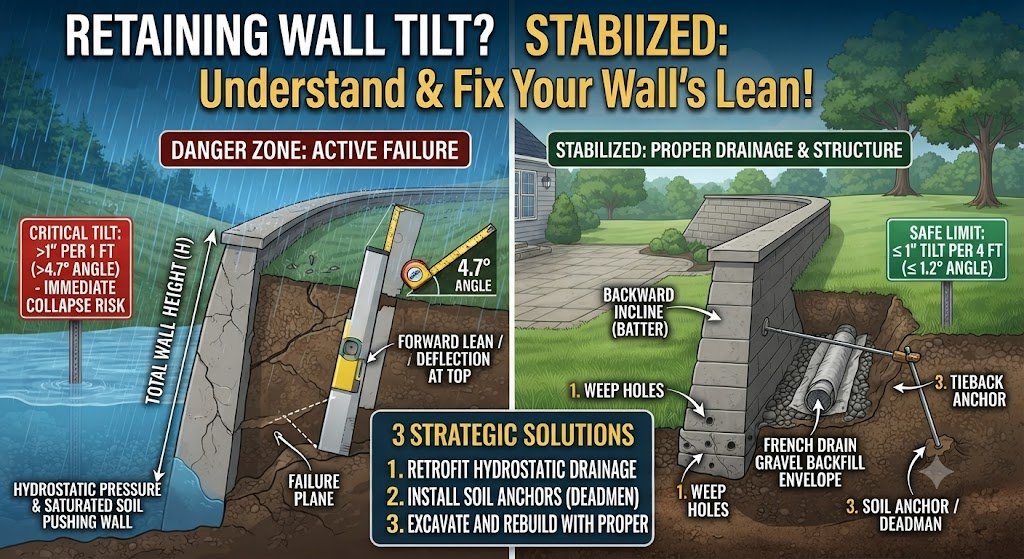
A retaining wall can develop movement gradually, sometimes before a homeowner realizes anything has changed.
Sometimes a small amount of movement is old, stable, and not an emergency. Other times, a leaning wall can indicate that water, soil pressure, drainage problems, erosion, construction issues, or another factor is putting more stress on the wall than it was designed to handle.
The tricky part is that there is no single amount of lean that can tell you whether a retaining wall is safe or about to collapse.
A measurement can be useful, but it shouldn’t be treated as a structural diagnosis.
Instead of asking only, “How many inches is my wall leaning?” look at the whole picture:
- How much has it moved?
- Is it continuing to move?
- Is the wall bulging or bowing?
- Are there cracks or separated blocks?
- Is water collecting behind it?
- Has the soil above the wall changed?
- Is anything heavy sitting near the top?
- Does the wall appear to be rotating, sliding, or settling?
This guide will help you document what you’re seeing, recognize warning signs, understand why drainage matters, and decide when it’s time to have the wall evaluated.
Important: A retaining-wall measurement cannot determine structural safety by itself. If a wall is rapidly moving, visibly failing, threatening a home or other structure, or showing signs of collapse, stay away from the area and contact an appropriately qualified professional. Don’t approach an actively failing wall just to take measurements.
How Much Lean Is Too Much for a Retaining Wall?
This is one of the most common questions homeowners ask, but unfortunately there isn’t a universal number of inches per foot that separates a “safe” retaining wall from a dangerous one.
A retaining wall is an engineered system. Its stability depends on much more than the angle of its face.
Depending on the wall, an evaluation may need to consider:
- Wall height and geometry
- Wall material and construction
- Soil type and condition
- Groundwater and drainage
- Backfill material
- Reinforcement or tiebacks
- The wall’s footing or base
- Soil bearing capacity
- Resistance to sliding
- Loads near the top of the wall
- Slope conditions behind the wall
- Surface-water runoff
- How much the wall has moved and how quickly
That means a measurement such as “1 inch of lean” doesn’t have the same meaning for every wall.
So Why Measure the Lean at All?
Because change over time can be useful information.
If you measure the wall today and record the result, you can repeat the measurement later under similar conditions. If the measurement changes, that tells you something important that a single measurement cannot.
The goal isn’t to prove that your wall is safe.
The goal is to document its condition and determine whether it appears to be changing.
Our calculator below can help you calculate the wall’s approximate geometric lean and angle. It is a measurement and monitoring tool—not a structural safety test.
Retaining Wall Tilt Calculator
Use the calculator to estimate the amount of forward displacement relative to the wall’s height.
For the most useful comparison, take your measurement from the same location each time and record the date.
If the number changes, photograph the area and document what changed.
Important: A calculated tilt angle does not tell you whether a particular retaining wall is structurally safe. Do not use the calculator to decide whether it is safe to approach, repair, excavate behind, or modify a retaining wall.
Retaining Wall Tilt & Movement Calculator
Calculate the approximate amount of forward displacement relative to your wall height. This is a measurement tool, not a structural safety test.
Why Do Retaining Walls Lean?
A retaining wall is holding back soil that naturally wants to move downhill. That creates lateral earth pressure
against the wall.
That creates lateral pressure against the wall. A properly designed wall has to resist that pressure while also dealing with water, drainage, soil conditions, and other loads.
A wall can begin moving for several different reasons.
1. Water Is Building Up Behind the Wall
Water is one of the most important things homeowners should pay attention to.
When water accumulates behind a retaining wall, it can create additional pressure against the wall. That’s one reason retaining-wall systems commonly incorporate drainage features intended to move water away from the back of the wall.
Drainage problems can be caused by:
- Clogged outlets
- Unsuitable backfill
- Blocked drainage paths
- Changes in surrounding grade
- Damaged drainage pipe
- Downspouts discharging toward the wall
- Heavy rainfall overwhelming the drainage system
This is why a wall that suddenly starts moving after periods of heavy rain deserves attention.
2. The Soil Behind the Wall Is Moving
Soil isn’t a solid, immovable mass.
It can settle, erode, become saturated, expand, contract, or shift over time.
If the soil behind a retaining wall changes, the forces acting on the wall can change as well.
Look for clues such as:
- New depressions in the soil
- Soil slumping toward the wall
- Erosion channels
- Standing water
- Muddy or unusually wet soil
- Cracks developing in the ground above the wall
- Trees or landscaping that have shifted
- New soil or fill placed behind the wall
A retaining wall that has remained stable for years but begins moving after major grading, landscaping, drainage changes, or unusually wet weather deserves closer attention.
3. Something Above the Wall May Be Adding Extra Load
The soil itself isn’t necessarily the only load acting on a retaining wall.
Things near the top can add additional pressure, including:
- Vehicles
- Sheds
- Decks
- Patios
- Large landscaping features
- Heavy equipment
- Structures
- Large quantities of stored material
This is sometimes called a surcharge load.
A wall designed for ordinary residential landscaping may not have been designed to support a newly added structure or vehicle load close to its upper edge.
If something substantial has been added near the wall since it was built, mention that when having the wall evaluated.
4. The Wall May Have Construction or Design Problems
Some retaining walls begin moving because of problems with their original construction or design.
Depending on the type of wall, problems could involve:
- An inadequate base
- Poor drainage
- Unsuitable backfill
- Insufficient reinforcement
- Poor connections between wall components
- Improper grading
- Soil conditions that weren’t properly accounted for
A homeowner usually can’t determine the cause from the wall’s appearance alone. The important thing is to recognize the signs and document changes rather than assuming you know exactly what’s happening.
5. Erosion or Changes to the Property Can Affect the Wall
The area around a retaining wall can change substantially over time.
New drainage paths, erosion, landscaping, excavation, tree removal, construction, or changes in grade can alter how water and soil interact with the wall.
If the wall began moving after another project changed the property, make note of what changed and when.
7 Warning Signs That Deserve Attention
A leaning wall isn’t automatically an emergency, but these signs can indicate that the wall is experiencing movement or distress.
1. The Lean Is Getting Worse
This is one of the most useful things you can monitor.
A wall that has looked essentially the same for many years is different from a wall that has visibly moved over the past few months.
Take photographs from the same position and record measurements over time.
If the movement is increasing, don’t rely on a single calculator result to decide whether the wall is safe.
2. The Wall Is Bulging or Bowing
A wall doesn’t always move as one flat surface.
Individual sections can bow outward, separate, or develop localized bulges.
That can be particularly important for segmented block, masonry, timber, or other walls where individual components may move differently.
Photograph any change and have significant movement evaluated.
3. Cracks Are Appearing or Getting Larger
Watch for:
- New cracks
- Widening cracks
- Cracks through masonry or concrete
- Separating blocks
- Gaps developing between sections
- Cracks in the soil behind the wall
A crack by itself doesn’t tell you exactly what is happening, but a crack that is new or rapidly changing is worth documenting.
4. The Wall Is Separating From Nearby Structures
Pay particular attention if the wall is close to:
- A house
- Garage
- Driveway
- Patio
- Walkway
- Fence
- Utility equipment
Movement that could affect another structure raises the stakes considerably.
If the wall appears to be moving toward a structure, don’t attempt to stabilize it yourself before understanding what is happening.
5. Water Is Collecting Behind the Wall
Look for:
- Standing water
- Muddy soil
- Constantly damp areas
- Water emerging through unexpected locations
- Blocked or damaged drainage outlets
- Downspouts discharging toward the wall
Drainage problems can be an important part of retaining-wall failures.
That doesn’t mean every wet wall needs to be rebuilt, but it does mean the source and path of the water need to be understood.
6. The Ground Above the Wall Is Cracking or Slumping
Don’t look only at the wall itself.
From a safe location, look at the soil above the wall.
Large cracks, settlement, erosion, or a developing depression can indicate that the ground behind the wall is changing.
If the ground is actively moving, stay away from the edge and have the situation evaluated.
7. The Wall Suddenly Changes After Heavy Rain
A wall that moves noticeably following a major rainfall event deserves attention.
Water can change soil conditions and increase pressure behind a retaining wall. Drainage systems can also become overwhelmed or obstructed.
If you notice a new lean, bulge, crack, or other change after heavy rain, photograph it and document the conditions from a safe location.
How to Monitor a Leaning Retaining Wall
If the wall doesn’t appear to be in immediate danger, documenting its condition can be useful.
Take Photographs
Take photos from the same locations each time.
Include:
- The entire wall
- Close-ups of cracks
- The soil above the wall
- Drainage outlets
- Areas where water collects
- Nearby structures
Try to keep the camera position and angle similar when taking comparison photographs.
Measure the Same Location
Pick a consistent location and record:
- Date
- Wall height
- Measured forward displacement
- Weather conditions
- Any recent heavy rain
- Visible changes
The goal isn’t to prove that the wall is “safe.”
The goal is to determine whether the condition appears to be changing.
If the wall is visibly unstable or actively moving, don’t approach it to take measurements.
What About Drainage?
Drainage is one of the most important things to investigate when a retaining wall is experiencing problems.
A properly designed retaining-wall system may use features such as free-draining backfill, drainage aggregate, perforated drainage pipe, outlets, or other methods of managing water.
The exact design depends on the wall and site.
That’s important because there isn’t one universal drainage fix for every retaining wall.
For example, simply drilling holes through an existing wall isn’t automatically an appropriate repair. The wall’s construction, location, drainage path, soil, and structural condition all matter.
If you suspect a drainage problem, the goal should be to determine where the water is coming from and where it needs to go, rather than simply creating an opening in the wall.
Should You Drill Weep Holes or Install a French Drain Yourself?
This is where caution is important.
You may see DIY advice suggesting that homeowners drill holes through a retaining wall or excavate behind it to install drainage.
That can be appropriate in some properly understood situations, but it isn’t a universal repair.
Excavating directly behind a leaning wall can remove soil that may currently be helping support it. Drilling into a wall can also damage reinforcement, utilities, waterproofing, or structural components.
If the wall is significantly leaning, actively moving, cracked, bulging, or supporting a structure, don’t start excavating behind it as a DIY experiment.
Have the condition evaluated first.
What About Retaining Wall Anchors or “Deadmen”?
Anchors, tiebacks, and deadman systems can be legitimate components of retaining-wall design.
But they aren’t a universal homeowner repair.
The anchor has to transfer forces into suitable soil, and the wall itself has to be capable of handling the forces introduced by the anchoring system.
Installing an anchor without understanding those forces can create a false sense of security—or make the problem worse.
If a retaining wall needs structural reinforcement, the appropriate solution depends on the wall’s construction and site conditions.
When Should You Call a Professional?
Consider having the wall evaluated if:
- The lean is increasing
- The wall is bulging or bowing
- Large or rapidly changing cracks are appearing
- Blocks or sections are separating
- The ground behind the wall is cracking or slumping
- Water is accumulating behind the wall
- The wall is moving toward a house or other structure
- The wall is tall, heavily loaded, or subject to unusual site conditions
- A driveway, deck, building, or other significant load is close to the wall
- You aren’t sure whether the movement is stable
For a potentially structural problem, the appropriate professional may be a qualified structural or civil engineer, geotechnical professional, or an experienced retaining-wall contractor, depending on the situation and local requirements.
Local building codes and permitting requirements can also vary.
What Should You Tell the Professional?
You can make an evaluation much easier by documenting the history of the problem.
Write down:
- When did you first notice the lean?
- Has it changed?
- Was there heavy rain before the movement?
- Has the property been graded or landscaped recently?
- Was anything heavy added near the wall?
- Where does water drain during storms?
- Are there cracks or bulges?
- Has the wall ever been repaired?
- Do you have photographs from previous years?
Your photographs and measurements can provide useful information even though they cannot replace a professional evaluation.
The Bottom Line
A leaning retaining wall isn’t automatically a disaster.
Some walls move slightly and remain stable for long periods. Others develop progressive movement because of drainage problems, soil conditions, construction issues, loading, erosion, or a combination of factors.
There is no universal “safe tilt” number that can diagnose every retaining wall.
That’s why the most useful approach is to look at the entire situation.
Measure the movement.
Document changes.
Look for drainage problems.
Watch for cracks, bulging, soil movement, and changes after heavy rain.
And if the wall is rapidly moving, visibly collapsing, or showing severe bulging, displacement, or ground movement, keep your distance and get qualified help.
The calculator on this page can help you understand and document the geometry of the wall’s movement—but it cannot certify a retaining wall as safe or predict when it will collapse.
That’s an important distinction, and one worth keeping in mind whenever you’re trying to diagnose a problem with your home.
A Note From Static & Smoke
We created Static & Smoke to help homeowners understand the strange, frustrating, and sometimes expensive problems that happen around a house.
Our goal isn’t to tell you that every problem requires a professional—or that every problem can be fixed with a five-minute DIY trick.
It’s to help you understand what you’re looking at, what questions to ask, what you can reasonably check yourself, and when it’s time to bring in someone with the right expertise.
Because sometimes the most useful answer is simply knowing what you don’t know yet.
🛠️ What should we break down next? Let us know your suggestions in the comments—or drop us a line directly through our Contact Page!
1 thought on “My Retaining Wall Is Leaning: Is It Dangerous? 7 Signs You Shouldn’t Ignore”