
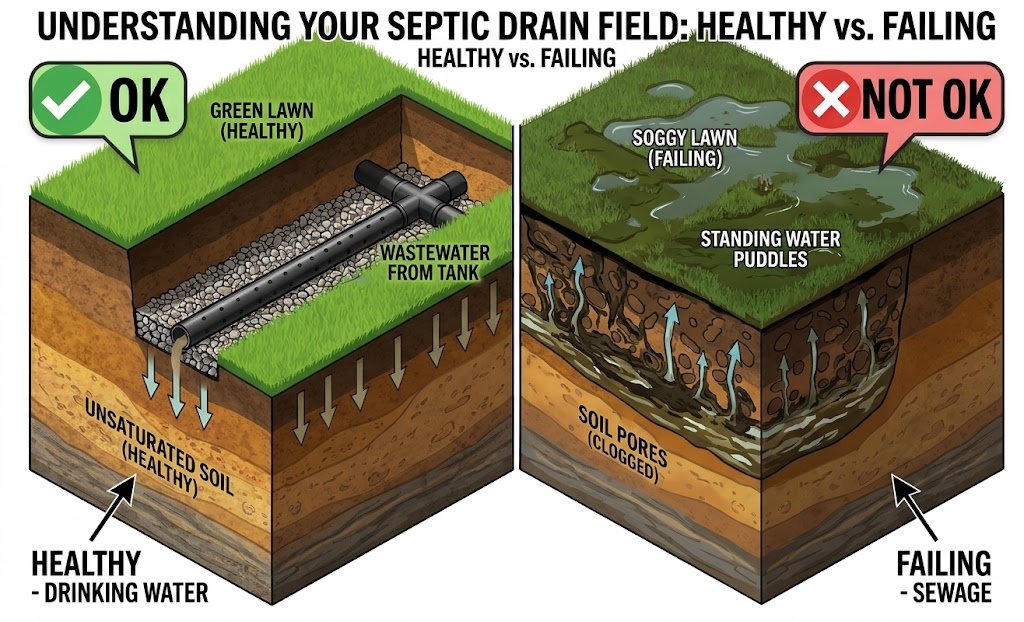
Preventing total septic drain field failure begins with understanding how the surrounding soil treats and disperses wastewater leaving the septic tank. Natural soil microorganisms, physical filtration, and the movement of water through unsaturated soil help process wastewater and reduce contaminants as it moves through the drain field. Over time, heavy household water loads, poor tank maintenance, or elevated groundwater can restrict soil absorption. Depending on the nature and severity of the problem, wastewater may back up into household plumbing or appear at the ground surface near the drain field.
| Drain Field Component | Normal Operating Role | Potential Contributor to Restricted Absorption | Safe Observation Signal |
| Effluent Distribution | Evenly spreads clarified liquid across gravel trenches or chambers | Uneven distribution overloading isolated trench sections | Soft or unusually green turf above specific drain lines |
| Biological Biomat | Naturally developing biological layer that contributes to wastewater treatment | Excessive accumulation may restrict infiltration | No ordinary surface observation can reliably identify biomat condition |
| Receiving Soil | Absorbs liquid via gravity percolation and soil structure | Restrictive soil conditions or a high seasonal water table limiting wastewater movement and treatment | Standing water in yard after heavy rain or laundry cycles |
How a Septic Drain Field Works
A residential septic system functions as a two-stage wastewater treatment system when one or both is compromised it leads to a septic drain field failure. As outlined by the U.S. Environmental Protection Agency (EPA), the primary septic tank acts as a settling vessel, separating heavy solids (sludge) at the bottom and floating fats, oils, and grease (scum) at the top. The clarified liquid layer in the middle—known as effluent—discharges into the soil absorption area (drain field) through a network of perforated pipes, gravel trenches, or gravelless chambers.
Once effluent leaves the distribution pipes, it passes into the native underlying soil. Here, natural soil microbes, physical filtration, and unsaturated soil conditions work together to process organic compounds and reduce contaminants. The soil’s ability to process wastewater depends on soil structure, moisture levels, and hydraulic load.
What Is a Septic Biomat?
A biomat is a naturally developing layer of microorganisms and organic material that forms along the infiltrative surfaces of a conventional soil absorption system. Its biological activity contributes to wastewater treatment, while the layer itself influences how quickly effluent enters the surrounding soil.
- Pathogen Reduction: The soil treatment process, supported by biological activity at the infiltrative surface, helps reduce pathogens before effluent migrates deeper into the subsoil.
- Flow Influence: The biomat affects how quickly wastewater moves from the drain field into the surrounding soil. Excessive accumulation can contribute to restricted infiltration.
Far from being an inherent system flaw, a healthy, stable biomat is an intended component of conventional soil absorption design.
Understanding Septic Drain Field Failure vs. Biomat Development
While biomat formation is standard, problems arise when environmental or operational conditions cause excessive biomat accumulation, restricted soil infiltration, or eventual septic drain field failure.
Repeated hydraulic overloading can keep soil near the infiltrative surface excessively wet, reducing the availability of oxygen needed by aerobic soil microorganisms. This can affect the biological and physical processes involved in wastewater treatment. However, it is vital to distinguish between a natural biomat, excessive biological accumulation, and external hydraulic overload. A soggy lawn or slow toilet does not automatically mean a biomat has failed. Elevated groundwater, damaged distribution pipes, clogged outlet filters, plumbing restrictions, and other conditions can also contribute to septic system symptoms.
7 Factors Contributing to Septic Drain Field Failure
[ High Household Water Use / Excess Solids Carryover ]
                         │
                         ▼
       [ Increased Hydraulic or Solids Loading ]
                         │
                         ▼
       [ Possible Drain Field Performance Problems ]
                         │
                         ▼
 [ Slow Absorption / Surface Wetness / Plumbing Backup ]
- Hydraulic Overloading: Excessive household water use can send more wastewater into a drain field than the system was designed to handle. Heavy rainfall, groundwater conditions, or repeated high-volume water use can further affect the soil’s ability to accept wastewater.
- Excessive Solids Carryover: When a septic tank is not properly maintained, accumulated solids can move toward the outlet and enter downstream components. Excessive solids carryover can contribute to clogged pipes, filters, and drain field surfaces.
- Unsuitable Soil Conditions: Restrictive soil layers and unsuitable soil conditions can limit wastewater movement and treatment.
- High Seasonal Groundwater: Rising seasonal groundwater can reduce the separation between the drain field and the water table, limiting the unsaturated soil available for wastewater treatment.
- Soil Compaction & Surface Alterations: Vehicles and heavy equipment traveling over a drain field can compact the soil and potentially damage buried distribution components. Structures, paving, and other inappropriate surface alterations can also interfere with normal drain field conditions.
- Chemical & Household Cleaners: Certain household chemicals, solvents, paints, oils, and other inappropriate materials can interfere with septic system operation or introduce contaminants into the wastewater. Homeowners should consult the EPA’s guide on How to Care for Your Septic System and avoid assuming additives or chemical treatments can restore a restricted drain field.
- Ineffective Distribution: A tilted, damaged, or improperly functioning distribution box can cause uneven wastewater distribution, potentially placing greater hydraulic demand on some trench sections than others.
Warning Signs of Septic Drain Field Failure Homeowners Can Observe
According to guidance on Signs of septic drain field failure from the Washington State Department of Health, homeowners can look for several key surface indicators:
- Unusually Green or Lush Grass: Bright green, unusually vigorous grass over or near drain field trenches can accompany excess moisture or wastewater movement near the surface, particularly during otherwise dry conditions.
- Spongy or Soggy Soil: Persistent wet or spongy soil over or near the drain field during otherwise dry weather can indicate excess moisture or a wastewater dispersal problem. Rainfall, surface drainage, and groundwater conditions can also contribute.
- Persistent Unusual Odors: Unpleasant odors around the septic tank or drain field can accompany system problems, although odors can also originate from normal venting or other sources.
- Gurgling Plumbing Fixtures: Hearing air bubbles or gurgling noises in toilets or shower drains when high-volume appliances discharge.
- Sluggish Drains: Sinks, tubs, and toilets draining slowly across multiple fixtures.
- Fixtures Backing Up: Wastewater flowing backward into lower-level shower basins or floor drains during heavy water usage.
- Standing Water Near the Drain Field: Persistent wet or ponded areas near the drain field, particularly during otherwise dry weather, can indicate a drainage or wastewater dispersal problem.
Important: These observations can indicate a septic system problem and potential for a septic drain field failure, but none independently confirms biomat accumulation or identifies the specific component responsible. Surfacing wastewater and sewage backups pose direct biological health risks and environmental hazards. Keep family and pets clear of saturated soil or ponding liquid. Contact a qualified septic professional if warning signs persist, multiple plumbing fixtures are affected, wastewater appears at the surface, or sewage backs up into the home.
Safe Homeowner Observation & Monitoring Guide
Homeowners should never open septic tanks, enter confined spaces, disturb soil around lines, or handle untreated wastewater. Safe monitoring focuses strictly on non-invasive recordkeeping:
1. Document Visual Changes From a Safe Distance
- Take date-stamped photographs of suspected wet areas or vegetation changes from a safe perimeter.
- Track whether standing water expands or recedes relative to recent rainfall and household laundry schedules.
2. Maintain a System & Water Usage Log
- Keep detailed records of septic tank pump-outs, filter cleanings, and professional service visits.
- Track daily household water usage during high-use periods to identify unusual consumption spikes.
3. Record Plumbing & Environmental Factors
- Note when sluggish drains or gurgling fixtures occur, taking note of which appliances were running concurrently.
- Cross-reference drainage issues with local rainfall totals or seasonal groundwater changes.
How a Professional Evaluates Septic Drain Field Failure
A qualified septic professional may evaluate several system components, depending on the symptoms, system design, and site conditions to figure out if there is a septic drain field failure:
- Primary Tank & Baffle Inspection: Checks sludge and scum layer depths, verifies baffle wall integrity, and cleans effluent filters.
- Distribution Box Alignment: Inspects the distribution box for damage, blockage, or improper positioning and evaluates whether wastewater is being distributed as intended by the system design.
- Trench Infiltration & Observation Risers: May inspect liquid levels in observation ports, where the system has them, to determine if trenches are holding water.
- Soil and Drain Field Evaluation: Assesses site conditions, groundwater influences, drainage behavior, and other factors that may affect the soil absorption area’s ability to accept wastewater. Additional testing may be appropriate depending on the system and observed conditions.
Frequently Asked Questions
Can septic drain field biomat buildup be treated with chemicals?
Homeowners should not assume that a chemical treatment or additive can restore a restricted drain field. Harsh chemicals, solvents, paints, oils, and other inappropriate materials should not be introduced into a septic system because they can interfere with normal system operation or introduce contaminants into wastewater. Commercial septic additives are not a substitute for proper maintenance, identifying the cause of a problem, or having the system evaluated by a qualified professional.
How often should a conventional septic tank be pumped?
Many conventional residential septic tanks are pumped approximately every three to five years, although actual intervals depend on tank size, household occupancy, wastewater volume, and accumulated solids. Inspection requirements are separate from pumping schedules and vary by system type and local jurisdiction. For example, Washington State generally requires gravity systems to be inspected at least every three years and other onsite sewage system types annually, subject to applicable local requirements.
Does soggy grass mean a total septic drain field failure has occurred?
Not necessarily. Surface wetness can stem from simple issues like a clogged effluent filter, a broken pipe, a tipped distribution box, or temporary heavy rain. A qualified septic professional must evaluate the entire system before determining if minor repairs, component servicing, or drain field replacement is required.
Interactive Septic System Water Usage Explorer
This educational tool divides estimated daily household wastewater volume by the entered drain field footprint area to illustrate basic volume relationships, rather than providing an engineering calculation or diagnostic result.
Interactive Septic System Water Usage Explorer
Explore how household water volume relates to a total drain field footprint. (Educational illustration only; actual soil capacity depends on site-specific soil texture, seasonal water tables, and engineering design.)
🛠️ What should we break down next? let us know your suggestions in the comments—or drop us a line directly through our Contact Page!