
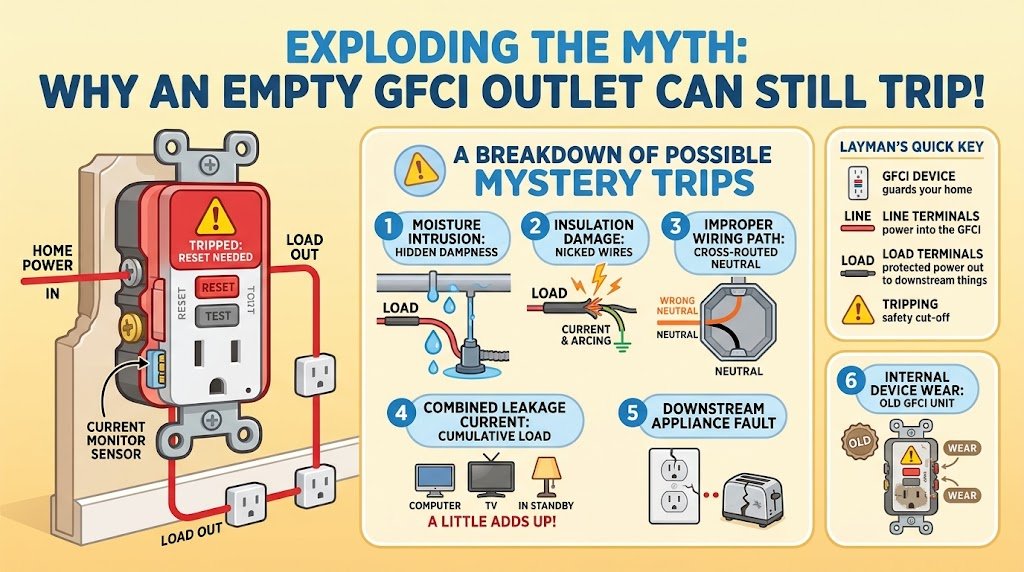
If a GFCI outlet keeps tripping even when nothing is plugged into its face receptacles, one possible explanation is that the device also protects downstream outlets, connected equipment, and wiring connected through its LOAD terminals. Moisture, insulation damage, improper wiring connections, or an aging GFCI receptacle are among several other possible explanations. The physical symptom alone does not identify the source of the problem, as a single GFCI receptacle is only one component within a broader electrical branch circuit.
What Is a GFCI Outlet?
A GFCI receptacle is a specialized safety device engineered to protect against electrical shock hazards by monitoring current balance. Understanding how these terminals operate helps clarify why a GFCI outlet keeps tripping. Inside the device, incoming power connects to the LINE terminals, while when the device is wired for downstream protection, additional outlets or equipment receive protected power through the LOAD terminals. Under normal conditions, the current flowing through the hot conductor matches the current returning through the neutral conductor.
Standard Class A GFCI devices are designed to respond to ground-fault current in the 4 to 6 milliampere range, de-energizing power to their face receptacles and any connected downstream terminals when that differential is detected, which explains why a GFCI outlet keeps tripping when minor current leakage occurs.
What Might Be Happening When a GFCI Outlet Keeps Tripping
When a GFCI outlet keeps tripping without any appliance plugged into its front receptacles, several distinct operational factors on the protected circuit may be interacting:
- Downstream Wire Insulation Issues: Physical degradation or moisture along conductors connected to downstream LOAD terminals can create unintended current paths to ground, explaining why a GFCI outlet keeps tripping without anything plugged into it directly.
- Atmospheric Moisture Exposure: Moisture intrusion, condensation, or water contamination inside outdoor receptacle boxes and electrical enclosures can create unintended conductive paths that contribute to ground-fault tripping.
- Neutral Conductor Path Configuration: An improperly shared or crossed neutral, or an incorrectly routed neutral return path, can cause returning current to bypass the GFCI’s intended sensing arrangement and disrupt its current balance.
- Combined Leakage Current: Small amounts of leakage current from multiple connected devices or equipment can contribute to a combined current imbalance that reaches the operating threshold.
- Downstream Connected Equipment: Hardwired appliances or other equipment connected farther along the protected circuit may develop internal leakage conditions associated with moisture exposure or component deterioration. Some electronic equipment can also produce small leakage currents during normal operation, depending on its design, even when the GFCI’s face receptacles are empty.
- Internal Device Condition: Over time, a GFCI receptacle can experience internal component wear or failure, making an aging device one possible explanation alongside conditions elsewhere on the circuit.
Why GFCI Protection Extends Beyond the Receptacle
Understanding why an empty GFCI outlet keeps tripping or can still trip requires examining how GFCI devices interact with broader residential wiring setups:
- Line vs. Load Terminal Setup: Power entering the LINE terminals can be routed through LOAD terminals to supply additional standard receptacles or fixtures throughout a room or building area.
- Active Downstream Loads: Lighting fixtures, appliances, or other equipment connected to the protected downstream circuit may remain energized even when the GFCI’s face receptacles are empty. If connected equipment develops unintended leakage current, it can trigger a trip.
- Current Differential Sensing: The GFCI compares the current passing through its hot and neutral conductors. Because downstream equipment receives power through the protected LOAD connections, an unintended current path farther along the protected circuit creates the imbalance that causes the device to trip.
- Downstream Circuit Conditions: An electrical condition farther along the protected circuit can affect GFCI operation whenever it creates an unintended current path or otherwise disrupts the expected hot-to-neutral current balance.
What the Homeowner Can Safely Observe
Homeowners can gather initial baseline clues about their system through safe, non-invasive visual checks:
- Noting Reset Behavior: Homeowners can note whether the GFCI resets successfully or immediately trips again. If the GFCI outlet keeps tripping do not repeatedly reset. Different GFCI models feature varied status lights and self-test routines, so consult manufacturer instructions when interpreting device indicators.
- Inspecting Exterior Enclosures: Checking outdoor or damp-location outlet covers for cracked weather gaskets, standing water, or loose faceplates provides a visual indicator of potential moisture exposure, though an enclosure that appears dry from the outside does not establish that its internal components or wiring are dry.
- Checking Wall Plate Condition: Looking for physical cracking or warping around the wall plate provides an important visual indicator. If unusual warmth or a burning odor is present, stop using the affected outlet and arrange prompt professional evaluation. If active smoke or sparking is observed, stay away from the area and contact emergency services immediately.
Safe visual observations can serve as a baseline clue, but they do not confirm the precise source of an electrical fault, total line integrity, or complete system status.
What Requires Professional Judgment
If a GFCI outlet keeps tripping without an obvious connected appliance, it should not be treated as proof that the receptacle itself has failed. Testing live electrical line voltages, examining internal junction box connections, isolating branch circuit conductors, and determining whether a fault stems from downstream wiring, neutral configuration issues, or an aging receptacle involves exposure to high-voltage hazards. A qualified electrician can determine whether the condition involves the GFCI device, protected downstream wiring, connected equipment, moisture exposure, or an improper wiring configuration. If issues persist or safety concerns arise, contact a qualified professional to evaluate your specific setup.
GFCI Current Differential Calculator
Frequently Asked Questions
Can a GFCI outlet trip if nothing is plugged into it?
Yes. A GFCI outlet keeps tripping sometimes because it protects more than its own face receptacles. When wired for downstream protection, it also monitors current passing through connected LOAD terminals to additional outlets, equipment, or wiring. Moisture intrusion, insulation damage, or leakage current elsewhere on that protected portion of the circuit can cause the GFCI to trip even when its front receptacles are empty.
Why won't my GFCI outlet reset when empty?
If your GFCI outlet keeps tripping or will not reset when empty, there may be an unresolved electrical fault, a problem with its power supply or wiring, or an internal device issue. Some models also include self-test features that prevent resetting when the device detects an internal problem. The inability to reset does not, by itself, establish which condition is responsible. Avoid repeatedly attempting to reset it and contact a qualified electrician if the problem continues.
How do I know if a GFCI outlet itself is bad or if the circuit has a fault?
When a GFCI outlet keeps tripping, its behavior can provide clues, but it cannot reliably distinguish an internal device problem from a downstream wiring or equipment issue without appropriate testing. An electrician can evaluate the receptacle, check its LINE and LOAD connections, and determine whether the problem involves the device or another part of the protected circuit. Disconnecting circuit conductors or testing internal connections should be left to a qualified professional.
Can humidity or damp weather cause a GFCI outlet to trip?
Humidity alone does not necessarily cause a GFCI to trip. However, condensation, water intrusion, or moisture contamination inside an outdoor receptacle box or other electrical enclosure can contribute to unintended current leakage. A Class A GFCI is designed to respond to a current imbalance in the 4–6 milliampere range, so relatively small leakage currents can cause it to trip.
One editorial note: The keyword appears four times, but it is slightly awkward in the first answer. For the most natural reading, I'd change its opening to: “Yes. A GFCI outlet keeps tripping in some situations because it protects more than its own face receptacles.” That preserves the exact keyword while making the sentence flow better.
🛠️ What should we break down next? let us know your suggestions in the comments—or drop us a line directly through our Contact Page!