
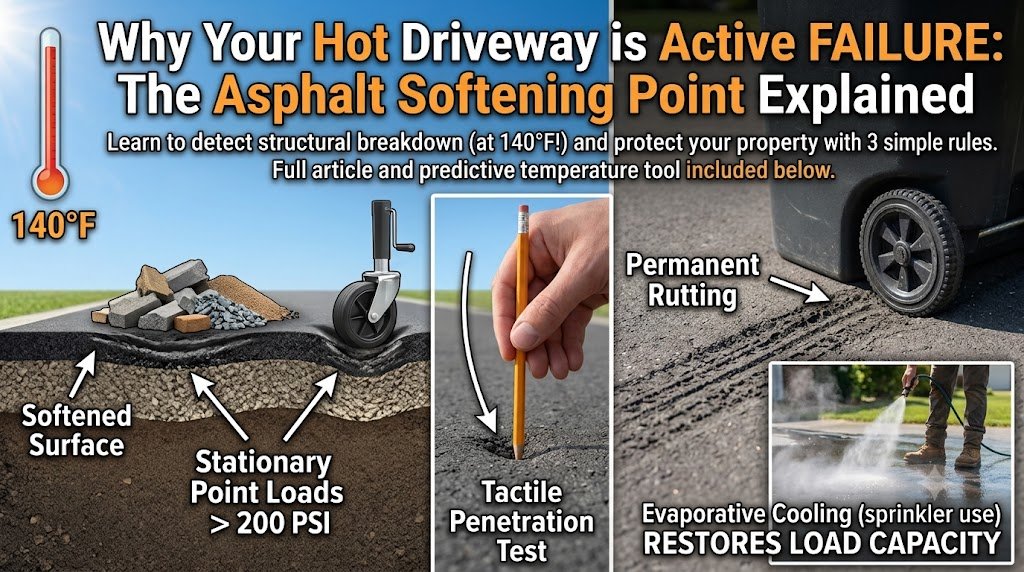
Every mid-summer heatwave triggers an expensive, frustrating headache for suburban property owners as their driveways rapidly approach a critical asphalt softening point: heavy plastic trash cans leave deep, permanent indentations, vehicle tires leave dark tracks on the garage apron, and sticky black tar attaches itself to your shoes. It feels like your driveway is actively melting beneath your feet. For most homeowners, this is a minor daily annoyance. In reality, it is a visible structural alarm pointing directly to the hidden thermodynamic limitations of modern residential installations.
The widespread assumption is that a driveway must reach a liquid state before structural degradation occurs, but structural compromise begins much earlier. Preventing expensive surface displacement, aggregate shifting, and deep ruts requires an understanding of the specific temperature threshold where residential pavement reaches its asphalt softening point and loses its load-bearing capacity.
Asphalt Yield Limit Calculator
The Core Threshold: When Asphalt Becomes Fluid
Residential driveways begin to structurally experience a critical asphalt softening point at surface temperatures of 140°F (60°C). This specific thermal threshold is reached when ambient air temperatures hit just 90°F (32.2°C) due to a low light reflectance value (LRV). Standard residential asphalt binders undergo rapid viscoelastic deformation under stationary point loads exceeding 200 PSI at this thermal baseline. To prevent permanent ruts, vehicles should be moved to concrete transitions or parked on load-distribution pads once the cross-section reaches this critical asphalt softening point zone.
The Viscoelastic Breakdown: Why the Surface Yields
To fix a soft driveway, you have to understand that asphalt concrete is not a completely rigid solid like cured Portland cement. It is a composite material consisting of mineral aggregate bound together by petroleum-based asphalt cement, classified under strict performance standards by organizations like the Asphalt Institute. This binder is highly viscoelastic, meaning its physical properties exist on a spectrum between a viscous liquid and an elastic solid, changing entirely as the pavement approaches its asphalt softening point.
As solar radiation hits the dark surface, the material acts as a highly efficient thermal battery. The binder reaches its specific asphalt softening point—the temperature at which the material can no longer support its own weight or external forces without measurable fluid displacement. At this exact physical inflection point, the molecular bonds within the bituminous binder stretch and slip. When a heavy vehicle tire or a concentrated point load (like a motorcycle kickstand or a trailer jack) applies direct downward force, the aggregate particles shift laterally because the surrounding liquid matrix has reached its asphalt softening point and can no longer lock them into position.
Micro-Friction and the 200 PSI Structural Limit
When a vehicle sits stationary on hot pavement, the weight isn’t distributed across the whole driveway; it’s focused entirely on the small contact patches where the rubber meets the road.
If the internal binder temperature climbs past the asphalt softening point, the micro-friction between the aggregate stones collapses. Standard passenger cars can easily exert localized point pressures exceeding 50 to 80 PSI. If you use a mechanical bottle jack, park a heavy commercial vehicle, or leave a loaded utility trailer on the blacktop without support pads, that pressure spikes well past 200 PSI. Because the aggregate framework is suspended in a compromised binder at its asphalt softening point, the material moves downward and outward, forming a permanent depression called a rut.
Three Rules to Protect Your Driveway in Peak Summer
You do not have to rip out your driveway to prevent thermal rutting. By controlling the surface temperature and managing static loads during the hottest hours of the day, you can successfully bypass the critical asphalt softening point entirely.
1. Distribute Localized Point Loads
Never park trailers, RV jacks, or motorcycles directly on hot blacktop. Place wide pieces of 3/4-inch exterior-grade plywood or specialized heavy-duty rubber pads beneath tires and stabilizers. This spreads the downward force over a massive surface area, dropping the localized pressure well below the structural failure threshold.
2. Manage the Light Reflectance Value (LRV)
Freshly laid blacktop absorbs up to 95% of all incoming solar radiation. Once a new installation cures for a full season, apply a high-quality polymer-modified asphalt emulsion sealer containing reflective additives. Increasing the reflectivity of the top seal layer drops the total thermal absorption, keeping surface temperatures beneath the critical asphalt softening point on hot days.
3. Deploy Targeted Evaporative Cooling
If you must park a heavy vehicle or move logistics equipment across a hot apron during a severe heatwave, run a lawn sprinkler on the surface for 15 minutes beforehand. The process of evaporative cooling drops the structural cross-section temperature by up to 30 degrees in minutes, restoring the binder to its solid, high-friction elastic state far below its asphalt softening point.
🛠️ What should we break down next? Let us know your suggestions in the comments—or drop us a line directly through our Contact Page!