
Few sounds in a basement cause as much immediate anxiety as water trickling during a heavy storm. A sump pump that starts, runs briefly, shuts off, and then starts again a minute later can be unsettling too.
That behavior is often called short-cycling. The important thing is that there is no universal number of seconds that defines a short cycle for every sump pump. Pump size, basin geometry, float-switch design, incoming water, discharge piping, and check-valve arrangement all affect how often a system should run.
Frequent starts are worth investigating because repeated motor starts and switch operations can increase wear. But the cycling pattern by itself does not tell you which component is causing the problem.
The useful question is not simply, “How many seconds should my sump pump run?”
It is:
Why is the sump pump turning on and off this often, and what can I safely observe before calling for help?
What Is Sump Pump Short-Cycling?
A sump pump cycles when its level control turns the pump on as the water rises and off after the water level falls.
A normal cycle might look like this:
Water level rises → pump starts → water level falls → pump stops → basin refills → pump starts again.
The amount of time between starts depends on how quickly water enters the basin and how much water the system allows to accumulate between the pump’s ON and OFF levels.
There is no universal rule that says a residential sump pump should run for 15, 30, or 45 seconds.
A pump may run for a relatively short period because the basin has little usable volume between its switch points. Another system may run much longer because it has more water storage between ON and OFF levels. Manufacturer instructions can also specify how a particular float or control should be positioned.
So, rather than treating a particular run time as a pass/fail test, look for a pattern that is unusual for your system.
For example, repeated cycles lasting only a few seconds, especially when accompanied by an immediate return of water to the pit, are worth investigating.
Why Frequent Sump Pump Starts Matter
Every time an electric motor starts, it experiences a starting current higher than its normal running current. Repeated starting also means repeated operation of whatever switch or control starts and stops the pump.
That does not mean a pump that cycles frequently during one storm is about to fail. Sump pumps are designed to operate automatically through changing water conditions.
The concern is repeated, unnecessary cycling over time. Depending on the pump and control design, frequent starts can contribute to wear on the motor and switching components.
The float or level-control arrangement is particularly important. Pump manufacturers specifically provide float-positioning instructions because inadequate or obstructed float travel can cause frequent cycling.
The practical takeaway is simple:
Don’t try to make your pump run for a particular number of seconds. Find out why the water level is moving through the switch points so quickly.
Why Float Travel Affects Sump Pump Cycling
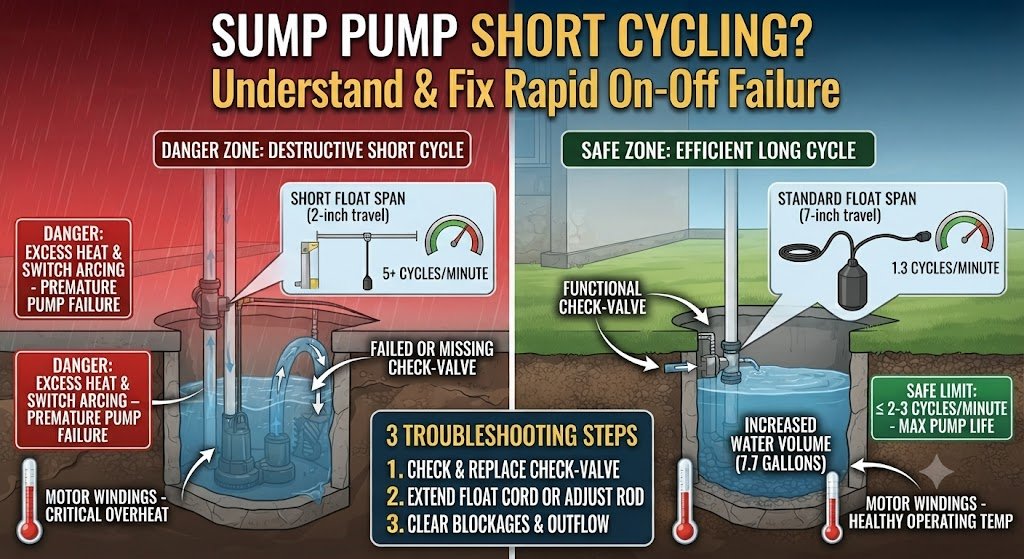
One useful way to understand sump-pump cycling is to calculate how much water is contained in the basin between the pump’s ON and OFF levels.
For a cylindrical basin: V=πr2h
where:
- V is the water volume in cubic feet
- r is the basin’s inside radius in feet
- h is the vertical distance between the ON and OFF water levels in feet
To convert cubic feet to gallons: gallons=V×7.48
Example: an 18-inch-diameter basin
Suppose, purely as an illustration, that a basin is 18 inches in diameter.
Its radius is: r=9 in=0.75 ft
If the water level moves through a 2-inch vertical range between the relevant switch points: h=2/12=0.167 ft
The volume is: V=π(0.75)2(0.167)≈0.295 ft3
But that is where the original calculation goes wrong: multiplying 0.295 cubic feet by 7.48 gives about 2.2 gallons, but the geometric calculation itself should use the actual cross-sectional area consistently. The correct calculation for a cylindrical 18-inch basin is: V=π(0.75)2(0.167)≈0.295 ft3
and therefore: 0.295×7.48≈2.21 gallons
So in this particular example, 2.2 gallons is correct.
Likewise, with a 7-inch vertical range: h=7/12=0.583 ft V=π(0.75)2(0.583)≈1.031 ft3 1.031×7.48≈7.71 gallons
The original volume calculations are therefore arithmetically consistent.
But the example does not establish a normal cycle time
Suppose the basin receives water at an assumed rate of 10 gallons per minute.
For 2.2 gallons of usable storage, the theoretical refill time is: 2.2/10=0.22 minutes
or about: 13.2 seconds
For 7.7 gallons: 7.7/10=0.77 minutes
or about: 46 seconds
Those numbers describe refill time under the stated assumptions. They do not tell you the complete sump pump cycle.
Why not?
Because a complete cycle also includes the time the pump is running and the actual rate at which the pump moves water under its installed discharge conditions.
The calculation is useful for understanding one important idea:
More usable water volume between the ON and OFF levels generally means fewer starts for the same incoming water rate.
It is not a test of whether your sump pump is correctly configured.
What this math does—and does not—tell you
This kind of calculation can help explain why a small change in float travel can have a noticeable effect on cycling.
It cannot tell you:
- whether the float is correctly installed
- whether the pump is correctly sized
- whether the pump is actually delivering its rated flow
- whether the discharge system is restricted
- whether the check valve is functioning
- whether the basin is adequately sized for the property
- whether the system complies with local requirements
- whether the pump is safe or likely to fail
Those questions require information about the actual installation and, in some cases, professional evaluation.
What Can Cause Frequent Sump-Pump Cycling?
There are several possibilities. The following are useful things to investigate, not diagnoses.
1. Water Is Returning to the Basin After the Sump Pump Stops
A sump-pump discharge line contains water after the pump shuts off. A properly installed check valve can prevent that water from flowing backward into the pit.
If the check valve is missing, incorrectly installed, or no longer functioning properly, some of that water can return to the basin and cause the pump to start again.
A noticeable rush or splash immediately after shutdown is an especially useful observation.
Manufacturers of sump-pump systems specify check valves for preventing discharge water from recirculating into the sump.
The amount of water that can return depends on the discharge pipe’s diameter and the length and configuration of the piping. So claims such as “5 to 10 feet of pipe equals a particular number of gallons” should not be treated as universal.
What to look for:
- Pump stops.
- A noticeable amount of water immediately flows back into the basin.
- The pump starts again shortly afterward.
That pattern can point toward a check-valve or discharge-piping issue, but it does not prove which component is responsible.
2. The Float or Level Control Has Too Little Effective Travel
The sump pump’s level control determines when it starts and stops.
Depending on the system, that control may be a tethered float, vertical float, separate float switches, or another control arrangement.
If the float is obstructed, improperly positioned, or installed with insufficient travel, the difference between the ON and OFF levels may be small. That means the pump can remove only a relatively small amount of water before shutting off.
Manufacturer instructions matter here. For example, Liberty Pumps’ installation instructions specifically address float travel and unobstructed movement and list improper float-switch adjustment as a possible cause of excessive cycling.
What to look for:
- The float appears to catch on the basin, piping, cord, or another component.
- The float has very little room to move.
- The pump starts and stops after only a small change in water level.
Don’t assume that a particular float position is correct just because it looks reasonable. Follow the instructions for the actual pump and switch.
3. The Discharge System Is Restricted
A blocked or restricted discharge line can affect pump performance.
Possible problems include:
- debris at an exterior discharge outlet
- a blocked or damaged section of discharge piping
- freezing in climates where the line is exposed to freezing conditions
- excessive discharge-pipe length or elevation for the pump
- other installation conditions that prevent the pump from moving water as intended
A restriction does not automatically cause short-cycling. In some installations, it may instead make the pump run longer because it is moving less water.
That distinction matters.
If the pump is running frequently and water is not leaving the system effectively, the discharge arrangement deserves attention. The actual effect depends on the pump and piping.
4. Discharged Water May Be Returning to the Foundation Drainage System
The water leaving the house needs to remain away from the foundation rather than immediately finding its way back into the drainage system.
If the exterior discharge location sends water toward the foundation, or the outlet is otherwise poorly configured, some of that water may eventually contribute to renewed inflow.
But this is not something you can establish simply by seeing a wet area outside.
Groundwater, roof drainage, surface runoff, foundation drainage, and other sources can all affect the amount of water entering a sump.
If the pump continues cycling heavily after rainfall has stopped, documenting what is happening outside can help a professional determine whether the discharge arrangement deserves investigation.
What You Can Safely Check Yourself
You don’t need to take the pump apart to learn useful information.
Watch one complete cycle
During a period when the pump is operating, observe:
- Where the water level is when the pump starts.
- Where the water level is when it stops.
- Approximately how long the pump runs.
- Approximately how long it stays off.
- Whether the water level falls significantly while the pump runs.
- Whether water visibly or audibly returns to the basin after shutdown.
The exact numbers are useful as observations, not as universal pass/fail thresholds.
For example:
“The pump runs for about 4 seconds, stops, and restarts about 12 seconds later.”
is much more useful to a technician than:
“The pump is short-cycling.”
Look at the float without reaching into the pit
If the float is visible, watch whether it moves freely.
Look for obvious interference from:
- the basin wall
- discharge piping
- the pump cord
- other cords or tubing
- debris
- a component that appears to restrict the float’s movement
Don’t move, tie, bend, or reposition the float simply to see what happens. The correct setup depends on the specific switch and pump.
Listen when the sump pump shuts off
A distinct rush of water immediately following shutdown is useful information.
It can be consistent with water returning through the discharge system, including a check-valve problem.
It isn’t proof by itself, but recording the sound or describing the timing to a professional can help.
Check the exterior discharge point
From a safe location, look at where the sump water exits the house.
Check for obvious:
- leaves or debris
- visible blockage
- damage
- standing water immediately around the outlet
- an outlet that appears to direct water back toward the foundation
Don’t dig up buried discharge piping just to find a blockage. If the line appears buried, frozen, damaged, or otherwise inaccessible, leave the investigation to someone equipped to evaluate it.
What Not to Do
A sump pit combines water and electricity, so troubleshooting should stay firmly on the observation side unless you know the system and its instructions.
Don’t reach into a sump pump basin while the pump or associated electrical equipment is energized. If equipment must be handled, follow the pump manufacturer’s electrical-safety instructions and disconnect the system from its power source before doing so. Manufacturer installation instructions commonly require power to be disconnected before handling or adjusting pump equipment.
Don’t deliberately manipulate the float to make the pump run repeatedly. That can create unnecessary starts and may produce a misleading test.
Don’t lift or pull the pump by its power cord. Manufacturer instructions specifically warn against using the power cord to lift or carry pump or float assemblies.
Don’t change float settings based on a generic internet recommendation. The correct settings depend on the actual switch and pump installation, follow the pump manufacturer’s instructions.
Don’t replace the sump pump with a larger model simply because it is cycling frequently. Pump capacity has to be considered together with the basin, incoming water, discharge piping, elevation, and control arrangement. A larger pump is not automatically the solution.
When Should You Call a Professional About Your Sump Pump?
Call for professional help when the cycling is persistent, the water level is rising unusually high, or the cause isn’t apparent from safe observation.
Professional evaluation is particularly appropriate if:
- the pump runs but appears unable to remove water effectively
- water repeatedly returns to the basin after shutdown
- the discharge line appears blocked or damaged
- the float or control appears defective or cannot move correctly
- the pump repeatedly trips a breaker or electrical protection device
- electrical components appear damaged
- the basin or drainage system seems inadequate for the amount of incoming water
- the basement is actively flooding or the pump cannot keep up
- you would need to cut, re-plumb, wire, disassemble, or otherwise modify the system to continue troubleshooting
The right professional depends on the problem. A plumber or sump-pump specialist may be appropriate for pump, check-valve, and discharge-piping problems. Electrical problems may require a qualified electrician. A larger drainage or groundwater problem may call for a contractor experienced in residential drainage or waterproofing.
If the system is keeping up and the issue is simply frequent cycling, you may not have an emergency. If the water level is rising toward the floor, the pump has stopped working, or water is entering faster than the system can remove it, the priority is preventing water damage rather than continuing to troubleshoot.
What to Tell the Professional
A few observations can make the service visit much more productive.
Have these details ready:
- Pump model and approximate age, if known
- How long the pump runs per cycle
- Approximately how often it restarts
- Whether water returns to the basin immediately after shutdown
- Whether the behavior happens only during rain
- Whether the cycling continues after the rain stops
- Whether the pump is keeping the water level under control
- What you observed at the exterior discharge point
- Any recent changes to the sump, plumbing, landscaping, or drainage system
A short video of a complete cycle can also be useful, provided you can record it without approaching energized equipment or standing in an unsafe area.
The Bottom Line
A sump pump that starts and stops frequently is worth understanding, but there is no universal “15-second” or “45-second” rule that determines whether the system is operating correctly.
The most useful clues are the relationship between water level, pump operation, float movement, and water returning to the basin.
Start with safe observation:
- Watch a complete cycle.
- Record the approximate run and rest times.
- Watch the water level.
- Listen for water returning after shutdown.
- Look for obvious float interference.
- Check the exterior discharge point from a safe location.
- Record the pump model and any unusual behavior.
Don’t treat those observations as a diagnosis. And don’t adjust or disassemble the system simply to chase a particular cycle time.
If the pump is keeping up with incoming water but cycling much more frequently than it normally does, the pattern is worth investigating. If the pump cannot keep the water level under control, is repeatedly tripping electrical protection, or requires electrical, plumbing, or structural work to diagnose, stop troubleshooting and get the appropriate professional involved.
The goal isn’t to make your sump pump run for a magic number of seconds. It’s to make sure the pump, level control, basin, and discharge system are working together as intended.
Sump Pump Simulator See the difference for yourself
The numbers above are easier to understand when you can see how the water level moves. This simplified simulator uses the same 18-inch basin example to show how changing the amount of water stored between switch points can affect how frequently the pump starts.
Sump Pump Cycling Simulator
See how the amount of water stored between pump ON and OFF levels can affect how often a sump pump starts.
Remember: This is a visualization, not a test of your sump pump. Your actual cycling depends on the pump, float or level control, basin, incoming water, check valve, and discharge system.
What to Take Away From the Simulation
The simulator demonstrates one important idea: when there is less water stored between the pump’s ON and OFF levels, the same incoming water can cause the pump to start more frequently.
That’s useful for understanding sump-pump cycling, but it isn’t a test of your actual system. Real-world cycling depends on the basin, pump, level control, incoming water, check valve, discharge piping, and the specific installation.
If your pump is cycling frequently, use what you’ve learned here to observe the real system rather than trying to match it to a particular number of seconds. Watch the water level, listen for water returning to the basin after shutdown, check for obvious float interference, and note what is happening at the exterior discharge point.
If you still aren’t sure what’s causing the behavior, that’s okay. You don’t need to diagnose the problem yourself before asking for help.
More Information
For general background, you can read the Wikipedia article on sump pumps.
If you have questions about a sump-pump problem you’re seeing in your home, contact Static & Smoke. When you reach out, include what the pump is doing, how frequently it cycles, how long it runs, and anything unusual you’ve observed.
The goal isn’t to make your pump fit a magic number. It’s to understand what your system is doing and know when it deserves a closer look.
🛠️ What should we break down next? let us know your suggestions in the comments—or drop us a line directly through our Contact Page!