
Nothing is more frustrating to a homeowner than watching $1,500 worth of freshly laid stone migrate into the county ditch after a single summer thunderstorm. For rural and suburban homeowners alike, keeping aggregate on a hill feels like a never-end battle against gravity. Understanding the physical limit of your gravel driveway washout slope is the difference between an enduring, maintenance-free driveway and a continuous, expensive cycle of rebuilding ruts.
When establishing or grading a path, the incline of your land dictates the rules of fluid dynamics. If your path exceeds a specific critical grade, gravity and flowing water will overpower the friction holding your aggregate together every single time. Before you order another dump truck of crushed stone, you must calculate your specific slope risk to determine if standard grading will suffice or if you require advanced stabilization.
What Slope Causes a Gravel Driveway to Wash Out?
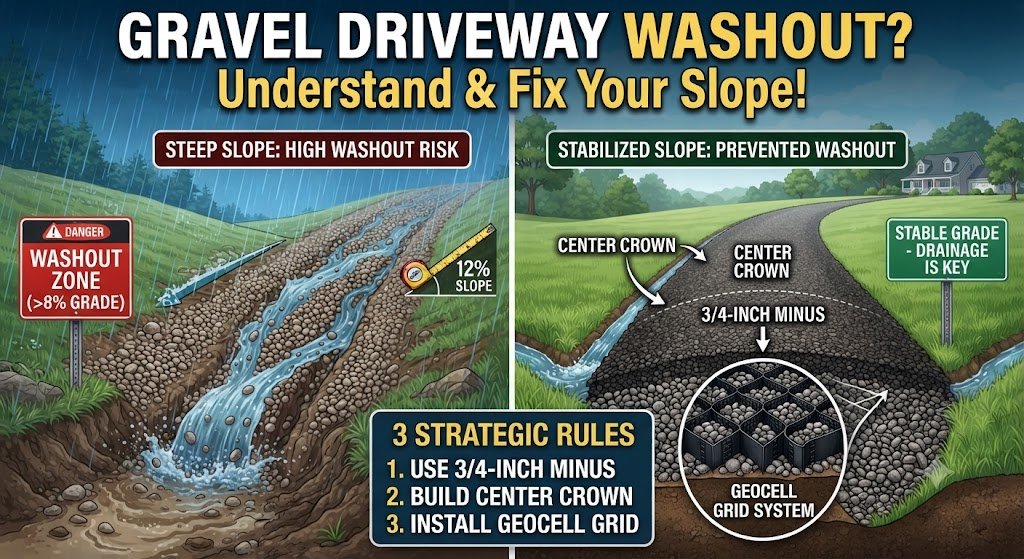
As a strict structural baseline, any gravel driveway washout slope exceeding 8% (a 1-inch vertical drop per 1 foot of horizontal run) is highly susceptible to severe, recurring water erosion. On slopes between 1% and 7%, washouts are rarely caused by gravity alone; instead, they are driven by poor crowning or a lack of compacted “minus” aggregate (fine rock dust) to bind the stones together. Once a gravel driveway washout slope climbs past 12%, loose aggregate is fundamentally unstable without mechanical stabilization grids or transitioning to chip-seal or asphalt.
The Layman’s Guide to Washout Physics: Why Rocks Move
To understand how a gravel driveway washout slope fails, we have to look at how water behaves on a hill. Water is lazy. It wants to take the fastest, steepest path to the lowest point of your property.
When rain falls on a flat gravel surface, it slowly percolates into the ground. However, when rain falls on an inclined driveway, gravity pulls that water downhill over the surface. As the angle of your slope increases, the speed of that surface water accelerates.
Water velocity behaves exponentially. If you double the angle of your slope, you don’t just double the speed of the water—you drastically increase its carrying capacity. Fast-moving water generates hydraulic shear stress. The moment the shear stress of the flowing water exceeds the physical weight and interlocking friction of your driveway gravel, the water picks up the rocks and carries them downhill. This is how minor tire ruts quickly transform into deep, impassable trenches.
Interactive Gravel Driveway Washout Risk Calculator
Use our custom, WordPress-safe simulator below. Input your driveway’s estimated slope percentage and select a typical rainfall scenario to instantly evaluate if your current setup is safe, or if you are heading toward a catastrophic wash.
Driveway Washout Risk Analyzer
Deep-Dive Property Science: The Hydraulic Math Behind the Washout
For those who want to verify the mechanical limits, we can look at the physical formulas governing aggregate stability. The exact threshold where a gravel driveway washout slope will fail is dictated by the Shields Parameter (τ*), which measures the ratio of fluid shear force to the gravitational force holding a sediment particle in place.
To visualize this, we use a classic fluid dynamics equation:
τ* = τ / [g × (ρ_s – ρ_w) × D]
Where:
- τ* (Tau) is the dimensionless Shields parameter.
- τ represents the boundary shear stress exerted by the flowing water.
- g is the acceleration due to gravity (9.81 m/s²).
- ρ_s (Rho-s) is the density of the gravel aggregate (typically around 2,650 kg/m³).
- ρ_w (Rho-w) is the density of water (1,000 kg/m³).
- D is the mean diameter of the individual aggregate stones.
In plain English, as your gravel driveway washout slope increases in angle, the boundary shear stress (τ) spikes. If the diameter (D) of your gravel is too small, or if the aggregate is too light, the water effortlessly shifts the stones. This is why small, round pea gravel is a complete disaster on hills—its spherical shape has zero interlocking friction, making it behave like miniature ball bearings under flowing water.
3 Strategic Rules to Defeat Hill Washouts
If your home’s driveway falls into a high-risk zone on our gravel driveway washout slope calculator, do not panic. You do not necessarily have to pay tens of thousands of dollars to pave it. You can beat the mechanics of a steep gravel driveway washout slope by applying three tactical adjustments:
1. Ditch the Round Stone: Use “3/4-Inch Minus”
Never put round river rock or clean stone on an incline. Clean stone means all the rocks are the exact same size with no dust. Without fines, the rocks cannot lock together. Instead, specify 3/4-inch minus (sometimes called crushed run, ABC, or road base). This aggregate contains sharp, jagged fractured stones mixed with fine stone dust. When compacted, the dust acts like natural cement, locking the larger jagged stones into a solid, cohesive driving surface.
2. Build a Severe Center Crown
The number one mistake homeowners make is grading their driveway completely flat. A flat road allows water to pool in tire tracks, softening the base and forming ruts. You must grade a steep driveway with a prominent center crown—a high point down the exact middle of the driveway that slopes downward at a 2% to 4% angle toward the outer edges. This forces water to run sideways off the road into side ditches, rather than letting it gather volume and speed running down the length of your driveway.
3. Deploy Modern Geocell Grid Systems
If you are dealing with a severe gravel driveway washout slope of 10% to 15%, standard compaction won’t hold up forever. The ultimate modern fix is installing a “Geocell” system. These are honeycomb-like plastic grids laid over a geotextile fabric and filled with gravel. The cell walls physically confine the aggregate, preventing the stones from migrating laterally under tire pressure or hydraulic forces.
With your driveway slope properly calculated and stabilized, you can stop watching your maintenance budget wash away with every summer storm!
🛠️ What should we break down next? let us know your suggestions in the comments—or drop us a line directly through our Contact Page!