
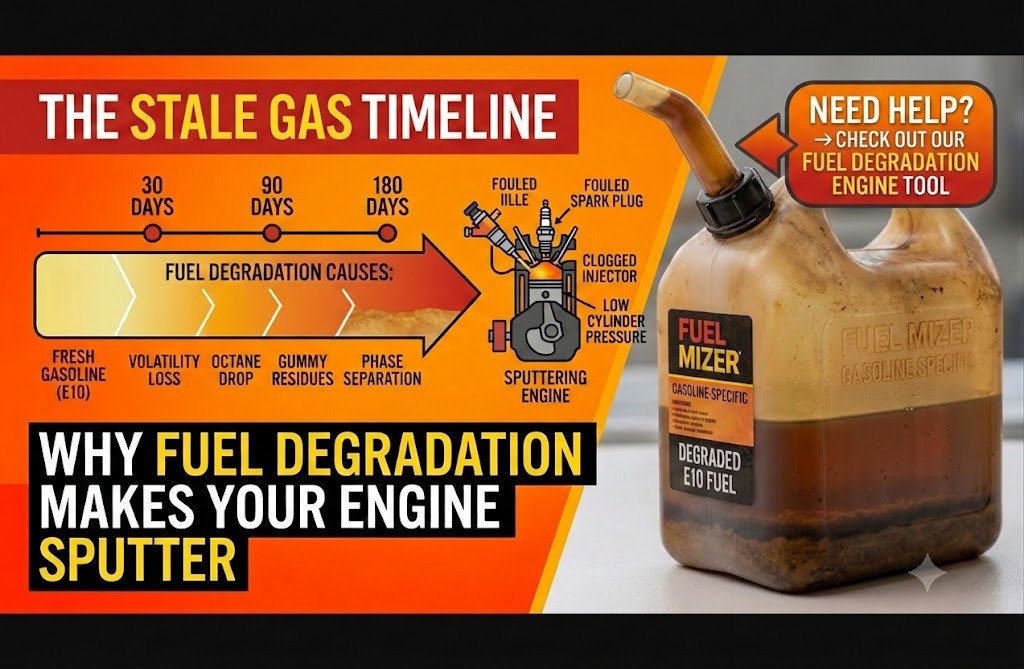
Standard E10 gasoline (the 10% ethanol blend you get at any standard gas pump) loses volatile combustion compounds and chemically degrades in just 30 days when kept in vented containers. For unblended E0 pure gasoline (the 10% ethanol-free gas you have to buy at specialty stations or select marinas), the expiration window extends to approximately 90 to 180 days before oxidation renders the fuel unstable.
As gasoline ages, fuel degradation strips away its light-end hydrocarbons—the highly volatile molecular compounds responsible for easy engine ignition. This causes the fuel to evaporate into thin air, leaving behind a heavy, stale fluid with a drastically reduced octane rating. When this degraded fuel hits a carburetor or fuel injector, it fails to vaporize cleanly, resulting in low cylinder pressure, fouled spark plugs, and a sputtering engine that chokes under load.
Wondering how much time your current tank has left? Avoid the guesswork by jumping directly to our interactive Fuel Degradation Engine to calculate an exact stability index for your specific fuel type and storage setup
The Chemistry of Stale Gas: Understanding Fuel Degradation
Gasoline is not a single substance; it is a complex cocktail of over a hundred refined petroleum hydrocarbons, additives, and detergents. The moment fuel leaves the pump nozzle, a ticking clock begins, and reversing fuel degradation becomes impossible due to two destructive chemical processes: oxidation and hygroscopic attraction.
Volatility Loss and Gummy Residues
When exposed to oxygen, the reactive components in fuel undergo a chain reaction that transforms smooth liquid hydrocarbons into sticky, solid polymers. This structural breakdown is a primary byproduct of fuel degradation, leaving a sticky goo that settles out of the fluid as a yellowish varnish or lacquer. This varnish lines the interior of fuel bowls, gums up needle valves, and completely plugs the microscopic orifices of a carburetor’s main jet, starving the engine of fuel.
The Ethanol Phase Separation Trap
Because the E10 fuel from standard gas pumps contains alcohol, it is inherently hygroscopic, meaning it actively draws moisture straight out of the surrounding air. In contrast, specialty E0 ethanol-free gas lacks this chemical vulnerability. In a vented fuel can or a partially empty equipment tank, pump gas absorbs moisture until it hits a critical saturation point, accelerating the overall pace of fuel degradation.
The Phase Separation Threshold: When moisture content in standard E10 pump gasoline reaches just 0.5% by volume at room temperature, the water and ethanol chemically bond and drop completely out of suspension. This creates a dense, watery, corrosive sludge layer at the absolute bottom of your fuel tank, leaving a low-octane, ruined layer of gas riding on top.
Data-Driven Analysis: The Fuel Degradation Matrix
The lifespan of your fuel depends directly on the fuel blend, storage containment, and local climate factors. To prevent severe fuel degradation, use the table below to track the exact countdown before fuel age risks causing mechanical damage.
| Fuel Type | Storage Container | Ambient Humidity | Days Until Degradation | Primary Engine Risk |
| E10 Regular (Standard Pump Gas) | Open/Vented Fuel Tank | High (Above 70%) | 15 to 30 Days | Phase separation; immediate water ingestion. |
| E10 Regular (Standard Pump Gas) | Sealed Plastic Jug | Moderate (50%) | 60 Days | Octane drop; sluggish cold starts; mild varnish. |
| E0 Pure Gas (Ethanol-Free Specialty) | Vented Equipment Tank | Any | 90 Days | Volatility loss; heavy varnish build-up in jets. |
| E0 Pure Gas (Ethanol-Free Specialty) | Sealed Metal Jerry Can | Low (Below 30%) | 180+ Days | Minimal risk; safe for long-term storage configurations. |
| Pre-Blended 2-Cycle Fuel | Engineered Sealed Can | Sealed Factory | 2 Years | Zero risk until unsealed; highly stabilized. |
Step-by-Step Workflow: Diagnosing and Fixing an Engine Impacted by Fuel Degradation
If your outdoor power equipment or vehicle starts up but stumbles, coughs, or dies when you press the throttle, follow this operational checklist to isolate and correct issues caused by standard fuel degradation.
1. Perform a Visual and Olfactory Inspection
Extract a small fluid sample from the bottom of the fuel tank using a siphon pump and place it into a clear glass jar. Fresh gasoline looks bright, clear, and has a sharp, distinct chemical odor. Advanced fuel degradation causes the liquid to appear noticeably dark amber or cloudy, smelling distinctively like sour varnish or old paint thinner. If you see two distinct layers of fluid in the jar, phase separation has occurred in your pump gas.
2. Isolate the Vaporization Deficit
To confirm the sputtering is caused by fuel degradation rather than an ignition component failure, remove the engine air filter element. Spray a 2-second burst of aerosol starter fluid directly into the intake throat and pull the starter cord. If the engine instantly roars to life and runs smoothly for a few brief seconds before dying again, your fuel system is choked with bad gas or restricted by stale lacquer deposits.
3. Evacuate and Recharge the System
Do not attempt to “run the bad gas through” the engine, as this can overheat valves and severely score cylinders due to lean combustion.
- Drain entirely: Use a fluid pump to completely empty the fuel tank.
- Purge the lines: Disconnect the fuel line feeding the carburetor and drain it into a waste container. Loosen the carburetor bowl drain screw to remove the sour sediment trapped inside the float bowl.
- Re-spike the system: Refill the tank with fresh E0 ethanol-free pure gasoline or high-octane premium fuel to reverse the early stages of component fouling and prevent future fuel degradation. Spiking the fresh container with a high-purity polyetheramine (PEA) fuel system cleaner will also actively dissolve remaining varnish traces.
Fuel Degradation Engine
Calculate real-world shelf life and phase separation stability indexes for gasoline stored in small engines or storage containers.
Frequently Asked Questions
Q: My lawn mower started up perfectly on year-old gas. Is the 30-day degradation limit a myth? A: Not at all, but it highlights the gap between chemical degradation and an engine’s tolerance threshold. Simple outdoor power equipment features basic carburetors and loose mechanical tolerances that can successfully ignite stale, low-octane fuel if it was stored in cool, dry conditions. However, the fuel is heavily degraded; burning it leaves behind carbon deposits and risks clogging tiny carburetor orifices over time.
Q: Can I use fuel stabilizers to fix or restore gasoline that has already gone bad? A: No. Fuel stabilizers are preventive chemical treatments, not restorative agents. They work by halting oxidation before it begins. Once gasoline has already undergone phase separation or broken down into lacquer and varnish, adding a stabilizer will not reverse the chemical damage or dissolve the solids. Heavily degraded fuel must be drained and replaced entirely.
Q: Is there a reliable way to make standard pump gas last longer? A: Yes. If you prefer buying standard E10 gas at a local pump, adding a high-purity fuel stabilizer on the very first day of purchase protects the fuel chemistry, slowing down oxidation for up to 12 months. For seasonal storage over the winter, the most absolute protection you can give your gear is running the fuel tank and lines completely dry.
Q: Why is the fuel degradation timeline different for a metal jerry can, a sealed plastic can, or inside a tool’s gas tank? A: Because different storage environments either accelerate or slow down how fast gasoline vaporizes and absorbs moisture. Standard equipment fuel tanks are vented and heavily exposed to outside temperature swings, causing them to actively draw in humid air and cut fuel shelf life exactly in half. Sealed plastic cans provide a decent baseline, but gasoline vapors can still slowly migrate through the pores of high-density plastic over several months. Heavy-duty, sealed metal jerry cans offer the maximum protection because the metal completely blocks vapor diffusion and handles internal pressure changes without venting.
🛠️ What should we break down next? let us know your suggestions in the comments—or drop us a line directly through our Contact Page!