
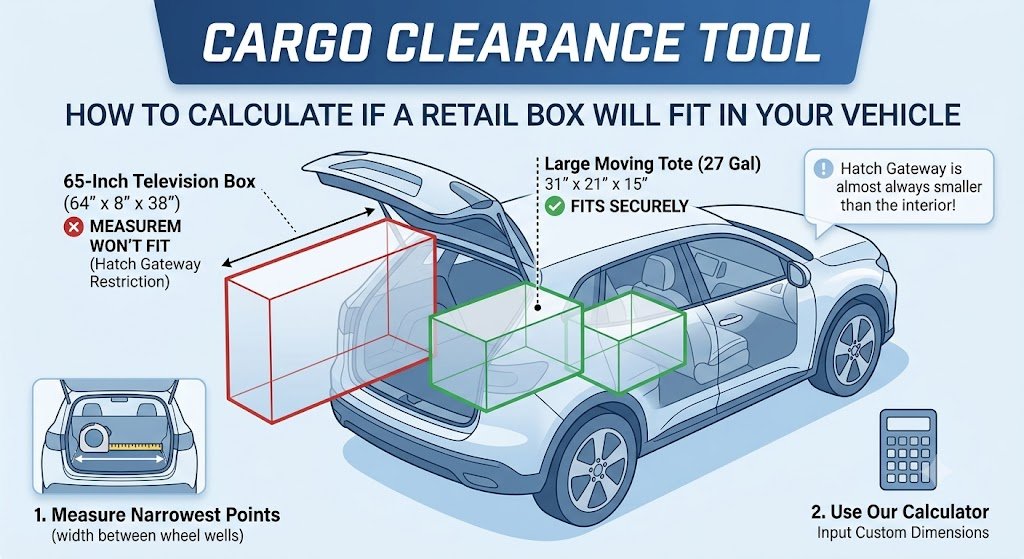
To determine if a commercial retail box will fit using a reliable Cargo Clearance Tool workflow, the item’s packaged dimensions must satisfy the absolute physical constraints of the vehicle’s narrowest entry clearance and internal spatial volume.
The primary mathematical rule for a straight-line loading clearance requires that the maximum box width, length, and height are each strictly less than or equal to the minimum corresponding dimensions of the vehicle hatch opening and interior cargo well: Box Width <= Cargo Minimum Width, Box Length <= Cargo Maximum Depth, and Box Height <= Cargo Minimum Height. If any single dimension of the retail packaging exceeds these gateway thresholds, the box will fail to load horizontally, requiring either diagonal rotation—which demands a minimum interior diagonal clearance calculated via the Pythagorean theorem where Diagonal = √(Width² + Height²) —or unboxing the item entirely.
Looking for the calculator? You can Jump Straight to the Interactive Cargo Matrix to test your custom dimensions, or keep reading below to break down the physical formulas.
The Three-Dimensional Constraints of Vehicle Cargo Clearance
When transporting large freight, freight forwarders and everyday couriers encounter distinct structural bottlenecks within a vehicle’s cabin. You cannot rely solely on the total cubic feet of cargo volume advertised by automotive manufacturers, as this metric represents total fluid space rather than usable, rigid rectangular clearance.
The Hatch Gateway Bottleneck
The hatch gateway is almost always smaller than the interior cargo area itself. The opening is frequently restricted by sloping rooflines, protruding taillight housings, and plastic interior trim panels.
Critical Safety Rule: Always measure the narrowest point of the hatch opening, which is typically found between the rear wheel wells or at the top lip of the rubber weatherstripping. A box that matches the interior width of a cabin will still fail to load if it cannot pass through the primary gateway lip.
Wheel Well Intrusion and Floor Angle: Cargo Clearance interruptions
Inside the vehicle, the wheel wells create a distinct physical narrowing. While a crossover SUV might boast an interior cabin width of 55 inches, the clear width between the wheel wells may drop to 41 inches or less. Furthermore, when rear passenger seats are folded forward, they rarely create a perfectly flat load floor. .The resulting incline reduces the effective vertical height clearance progressively as the box pushes deeper toward the front seats, directly impacting your cargo clearance limits.
Step-by-Step Cargo Clearance Workflow
To systematically verify freight compatibility before arriving at a retail loading zone, execute the following operational workflow:
1. Measure the Object’s True Packaging Dimensions: Do not measure the raw product. Obtain the manufacturer’s shipping box dimensions (Length, Width, Height). Retail packaging for electronics, furniture, and appliances often adds 4 to 8 inches of styrofoam buffering to the base item dimensions.
2. Determine the Vehicle Gateway Minimums: Open the rear hatch or trunk and measure the absolute minimum rectangular pass-through clearance to establish your baseline cargo clearance constraints. Record the minimum width at the floor, the minimum width at the top, and the vertical clearance from the floor lip to the upper weatherstrip.
3. Calculate the Maximum Usable Depth: Measure from the inside base of the closed rear hatch to the back of the front driver/passenger seats (set to your comfortable driving position).
4. Account for the Diagonal Incline: If a box must be tilted to slide past a sloping rear windshield, calculate the required dynamic clearing height. A box tilted at an angle requires a dynamic vertical clearance equal to: (Width × sin(Angle)) + (Height × cos(Angle)).
Retail Box Dimensions vs. Vehicle Class Cargo Clearance
The table below outlines standard retail box dimensions for common oversized consumer items juxtaposed against the typical clear rectangular thresholds of major vehicle classes.
| Retail Item Type | Standard Box Dimensions (L x W x H) | Minimum Vehicle Class Required | Common Structural Bottleneck |
| 65-Inch Television | 64″ x 8″ x 38″ | Midsize SUV / Minivan | Must be transported vertically to avoid panel damage; limits clearance. |
| Flat-Pack Sofa (3-Seater) | 85″ x 36″ x 25″ | Full-Size Cargo Van | Length exceeds rear-seat-to-hatch limits on all standard SUVs. |
| Compact Refrigerator | 24″ x 24″ x 35″ | Compact Crossover / Hatchback | Pass-through height at the hatch opening lip. |
| Large Storage Tote (27 Gal) | 31″ x 21″ x 15″ | Sedan (Trunk) | Trunk opening deck lid height often blocks entry entirely. |
| Mountain Bike (Boxed) | 55″ x 9″ x 32″ | Subcompact SUV (Seats Folded) | Front seat track intrusion limits overall horizontal depth. |
If you are hauling exceptionally heavy retail freight rather than just bulky boxes, ensure you also cross-reference your vehicle’s structural limitations using our Truck Math and Payload Capacity Guide to avoid suspension strain
Safety Tip: To protect your vehicle’s interior trim, never force a rigid container past the hatch weatherstripping. Use the calculator below to confirm that your item’s dimensions fit your vehicle’s clearance limits before you begin loading.
Cargo Clearance Calculator
Note: If your item can be rotated to better fit your vehicle’s clearance, simply swap the Box Width and Box Height measurements in the calculator above to see if it will fit.
Cargo Clearance Frequently Asked Questions
Why is the hatch gateway smaller than the interior cargo space?
The vehicle’s hatch opening is physically restricted by structural elements like sloping rear windshields, taillight housings, and thick rubber weatherstripping. Always calculate your entry limits based on the narrowest point of this gateway rather than the wider interior cabin dimensions.
Can I transport a 65-inch TV flat in a midsize SUV?
While a midsize SUV may have the interior depth to accommodate the length, transporting a large television flat can cause internal screen cracking due to road vibrations. It is always recommended to utilize a vertical cargo clearance layout to keep the panel secure and upright.
How do wheel wells affect my cargo clearance calculations?
Wheel wells create a major horizontal bottleneck on the vehicle floor, often narrowing your usable loading width by 10 inches or more. When measuring a rectangular retail box, ensure its width fits comfortably between the narrowest point of the wheel wells rather than the maximum door-to-door cabin width.
🛠️ What should we break down next? let us know your suggestions in the comments—or drop us a line directly through our Contact Page!