
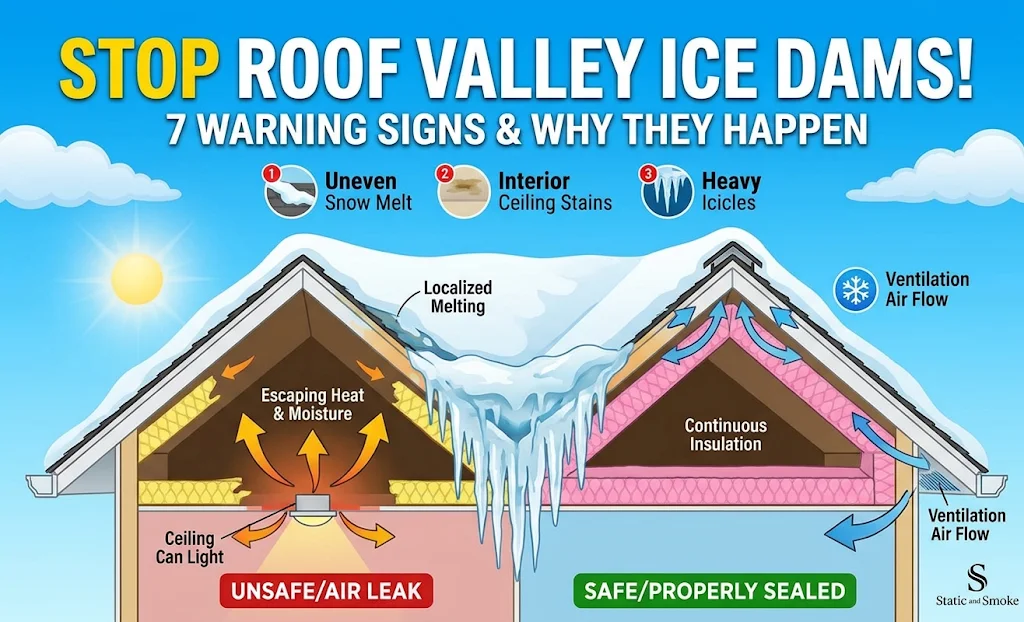
Roof valley ice dams can develop when melting snow and rainwater collect in areas where two roof sections meet, particularly when freezing temperatures interfere with normal drainage. Heat escaping through poorly insulated or inadequately air-sealed attic areas can contribute to uneven roof temperatures and snowmelt, while sunlight and changing outdoor conditions can also influence melting and refreezing. Understanding how roof valleys handle winter runoff, recognizing potential ice accumulation, and identifying conditions that may contribute to drainage problems can help homeowners determine when further professional evaluation may be appropriate and take informed steps to address potential concerns.
What Is a Roof Valley Ice Dams?
A roof valley is the sloping channel formed where two roof planes meet. These areas collect runoff from adjacent roof sections and direct it toward the lower roof edge. Ice can accumulate within a valley when water freezes along the drainage path, potentially restricting runoff and potentially creating roof valley ice dams.
A conventional ice dam, however, typically develops along the colder lower edge (eave) of a roof, where refreezing water creates an obstruction that can allow additional meltwater to collect behind it. Both conditions can affect roof drainage, but they do not necessarily develop in the same location or for exactly the same reasons.
How Roof Valleys Handle Drainage and Potential for Roof Valley Ice Dams
Roof valleys collect and direct water runoff from two adjacent roof slopes, concentrating liquid volume into a single channel. Because of this concentrated flow, proper construction and installation are critical for ensuring water sheds safely off the roof plane.
| Valley Construction Style | Construction & Installation Characteristics | Drainage & Maintenance Considerations |
|---|---|---|
| Open Metal Valley | Features an exposed sheet metal liner (such as aluminum, copper, or steel) installed along the valley intersection centerline prior to shingle application. | Provides an exposed, relatively unobstructed drainage channel when properly installed. Snow and ice can still bridge across the open metal during freezing weather. |
| Woven Shingle Valley | Shingles from both intersecting roof slopes are woven across the centerline in alternating layers, creating a continuous shingle surface. | Creates a seamless visual appearance. Manual ice clearance should be strictly avoided to prevent granule loss or shingle breakage. |
| Closed-Cut Valley | Shingles from one roof slope extend across the valley line, while shingles from the intersecting slope are cut in a straight line along the valley offset. | Provides a clean edge and effective water shedding when cut correctly. Improper installation can compromise water shedding and increase leakage potential. |
4 Factors That Can Contribute to Roof Valley Ice Dams Formation
Understanding how heat and air move through a building assembly helps clarify why certain areas of a roof experience uneven snowmelt while others remain sub-freezing.
1. Thermal Resistance Inconsistencies (Fourier’s Law)
Heat transfer through a building material is described by Fourier’s Law of Heat Conduction:
q″ = -k (dT / dx)
Where:
- q″ is the local heat flux vector (W/m²)
- k is the thermal conductivity of the material being evaluated (W/(m·K))
- dT / dx is the temperature gradient in the direction of heat transfer (K/m)
Where insulation is interrupted or reduced around complex framing intersections, the overall thermal resistance of that portion of the roof assembly may be lower. Depending on the construction details, this can allow more heat to move through the assembly and contribute to localized differences in roof surface temperatures. The actual temperature distribution depends on the complete roof assembly and surrounding environmental conditions.
To better understand how heat moves through roof framing and insulation gaps, building scientists rely on Fourier’s Law of Thermal Conduction, which explains how temperature differences across roof materials drive heat transfer into the attic.
2. Attic Air Leakage
Convective heat transfer through air leaks can contribute to attic heat accumulation. Escaping indoor air can introduce heat and moisture into attic spaces through unsealed ceiling penetrations—such as light fixtures, plumbing stacks, attic access hatches, and partition top plates—potentially warming portions of the roof assembly and contributing to uneven snowmelt. The extent and location of this effect depend on the building’s air barrier, insulation, framing, and attic configuration.
3. Attic Ventilation Dynamics
In appropriately designed vented attic assemblies, ventilation allows outdoor air to move through designated intake and exhaust openings. This airflow can help manage attic temperature and moisture conditions. However, ventilation is only one part of an effective roof assembly and does not replace continuous insulation and air sealing. Not every home is constructed with a conventional vented attic, and ventilation strategies must align with the specific building envelope design.
4. Phase Change Mechanics
Accumulated snow can receive thermal energy from several sources, including solar radiation and heat transferred through the roof assembly. When sufficient energy is available, some of the snow can melt into liquid water:
Q = m · L_f
Where L_f is approximately 334 kJ/kg (or 144 Btu/lb), representing the approximate latent heat of fusion of water. As this liquid runoff flows down toward unheated eaves or colder roof sections, it surrenders thermal energy to sub-freezing ambient air and can refreeze into ice.
7 Warning Signs of Potential Roof Valley Ice Dams Problems
Homeowners can monitor several visual indicators from ground level to recognize conditions that may indicate drainage or thermal issues:
1. Uneven Snow Melt
Snow melting quickly along roof valleys while remaining thick on surrounding slopes may indicate differences in surface heating, solar exposure, or localized insulation conditions.
2. Heavy Icicle Accumulation
Large icicles hanging from eave lines or valley overhangs can accompany ice dam conditions, though icicles do not independently establish that a dam exists.
3. Ice in Gutter Channels
Ice filling gutter troughs can interfere with proper drainage, though gutter ice alone does not establish a roof valley problem.
4. Interior Ceiling Staining
Discolored spots or peeling paint near interior ceiling-wall junctions can indicate water intrusion, though several roof or plumbing issues can cause similar staining.
5. Damp Attic Rafters or Sheathing
Dark wood or visible frost on the underside of roof sheathing near framing intersections may indicate moisture issues, though condensation and ventilation imbalances can also cause these conditions.
6. Water Near Exterior Siding or Soffits
Water appearing around soffit panels or running down exterior siding during snowmelt may indicate water intrusion or drainage problems. These observations do not establish whether an ice dam or another roofing issue is responsible.
7. Recurring Ice Accumulation
Ice repeatedly forming in the same general roof area may indicate a recurring drainage, insulation, air leakage, or roof design concern. The visible pattern alone cannot identify the underlying cause.
How to Safely Observe Winter Roof Conditions From the Ground
Homeowners can monitor roof performance safely without stepping onto ladders or roof surfaces:
- Observe Snowmelt Patterns: Look at how snow melts across different sections of the roof following a storm to notice uneven melting areas.
- Use Binoculars or a Camera: Examine valley lines, flashing, and eave edges safely from ground level.
- Inspect Downspout Outlets: From a safe ground-level position, look for visible ice blockages near downspout outlets. Blocked drainage can contribute to water accumulation around the gutter system, although it does not establish the cause of ice elsewhere on the roof.
- Observe Accessible Attic Spaces Safely: Observe visible conditions from an existing, safely accessible attic entry. Homeowners should not enter an attic if access requires stepping onto unfinished ceiling joists, moving insulation, or navigating around exposed electrical equipment. Actual air leakage testing requires professional evaluation tools.
Safe Practices vs. Unsafe Interventions
Attempting to clear ice manually can create severe safety hazards and damage building materials.
Safety & Operational Warning: Never climb onto snow-covered or icy roofs, attempt to chip away ice ridges with sharp tools, or work beneath heavy snow or ice accumulation. Falling ice and snow present major injury risks even to individuals standing on the ground. Physical impact can break cold asphalt shingles, tear underlayment, and lead to serious personal injury.
Avoid these hazardous practices:
- Chipping or Striking Ice: Hacking at ice with metal tools can damage roofing membranes, remove shingle granules, and damage gutters.
- Standing Beneath Overhangs with Rakes: Pulling snow or ice from roof valleys or overhangs while standing beneath heavy accumulation can expose homeowners to falling snow and ice. Avoid working beneath areas where material could slide or fall.
- Open Flames or Unapproved Heating Elements: Using blowtorches, open flames, or improvised heating equipment on a roof creates extreme fire and material damage risks.
- Unapproved Chemical Deicers: Chemical products not specifically approved for roofing materials may damage metal flashing, asphalt shingles, or surrounding landscaping.
- Unstable Ladder Work: Placing ladders on icy or uneven ground to reach high eave overhangs creates severe risk of falls.
Interactive Attic Heat Loss & Roof Valley Ice Dams Conditions Explorer
Use this educational reference tool to explore how attic features and winter conditions interact to influence roof melt dynamic.
Select your home’s attic and ventilation characteristics below to explore how insulation continuity and air sealing influence roof thermal behavior during freezing conditions.
Frequently Asked Questions About Roof Valley Ice Dams
What causes roof valley ice dams to form?
Roof valley ice dams and related ice accumulation can develop when snowmelt or rainwater enters a roof valley and encounters freezing conditions that interfere with normal drainage. Attic heat loss, air leakage, solar exposure, outdoor temperatures, and roof geometry can all influence melting and refreezing. The specific contributing conditions vary depending on the building and weather.
How are roof valley ice dams different from standard eave ice dams?
Standard ice dams typically develop along the colder lower edges of roofs, where refreezing water creates an obstruction that can allow additional meltwater to collect behind it. Roof valley ice accumulation develops within the channels where two roof slopes meet. Although both conditions can interfere with drainage, they do not necessarily develop in the same location or for the same reasons.
What are the main warning signs of roof valley ice dams?
Potential warning signs include uneven snowmelt across roof sections, visible ice accumulation within roof valleys, heavy icicles, ice-filled gutters, and water staining on interior ceilings. These observations can indicate drainage or moisture concerns, but none independently establishes the presence or exact cause of a roof ice dam.
How can homeowners safely manage roof valley ice dams?
Homeowners should avoid climbing onto icy roofs, striking ice with sharp tools, or using improvised heating equipment to remove accumulated ice. Instead, observe roof conditions from a safe ground-level position and look for visible drainage concerns around accessible downspout outlets. If ice accumulation is accompanied by interior leaks, recurring water intrusion, or significant roof damage, consult a qualified roofing professional. Attic insulation, ventilation, and air leakage concerns may require additional evaluation by an appropriately qualified building-envelope or insulation professional.
🛠️ What should we break down next? let us know your suggestions in the comments—or drop us a line directly through our Contact Page!