
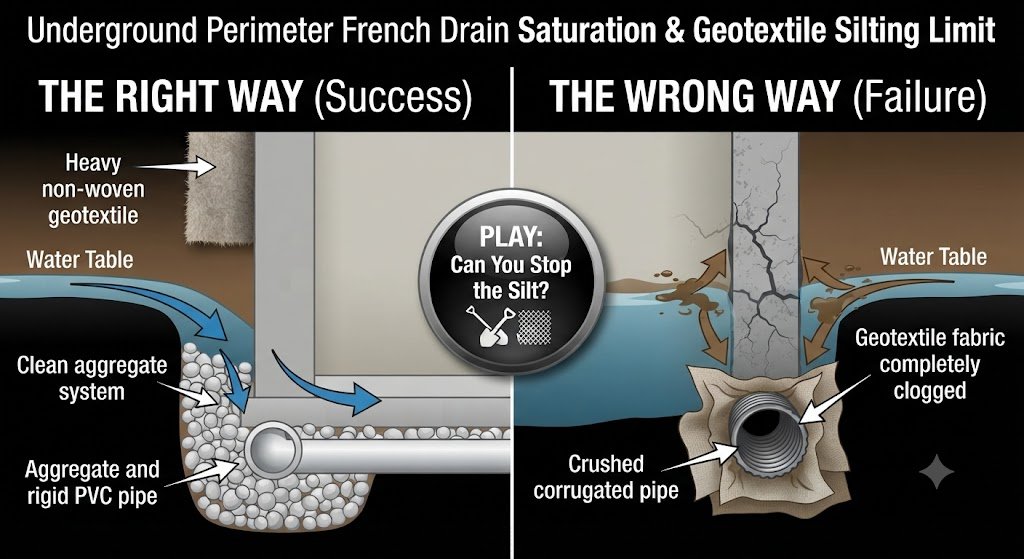
French drain depth is the single most critical factor determining whether your yard drainage system will survive heavy storms or fail prematurely. Did your DIY system stop working after just two heavy seasons of rain? The failure is almost always caused by soil fines migrating through the gravel and silting up the pipe perforations because of an incorrect geotextile fabric non-woven weight rating.
There is nothing more stressful than watching a torrential rainstorm turn your yard into a muddy swamp, especially when you spent an entire weekend digging trenches, hauling gravel, and laying pipe. When an underground perimeter drainage system backs up, water stops flowing away from your structure and instead saturates the subsoil directly against your foundation walls. When a French drain fails prematurely, homeowners usually assume the pipe crushed under the earth or the slope was too shallow. In reality, the culprit is underground silting—microscopic clay and silt particles slipping past cheap filter fabric and choking out the pipe perforations completely.
Jump down to play The Silt Shield Catchment Game and test your structural logic!
Why Your French Drain Fails Over Time
Most property owners assume that once a perimeter trench is filled with stone and buried, the drainage problem is solved for good. It is not. Over time, hydrostatic pressure from surrounding clay and loam pushes fine sediment suspended in groundwater directly toward the path of least resistance.
The symptoms of a silted-out French drain are distinct and severe. If water pools in your yard in the exact same spot weeks after a storm has passed, or if you dig down to your corrugated pipe and find it encased in a thick, impermeable mud cake, your system’s french drain depth and filtration layer have failed. Without proper soil separation, the gravel voids fill with sludge, neutralizing the entire drainage network.
The Hydrology Behind the French Drain Depth and Silting Limit
To understand why proper french drain depth and fabric specification matter, we have to look at the mechanics of subsurface hydrology. Water moves through the soil profile via gravitational pull and capillary action, carrying suspended soil particles with it.
This subsurface movement is governed by Darcy’s law for fluid flow through porous media: Q = -k * A * (dh/dl). In this formula, k represents the hydraulic conductivity of the surrounding soil matrix. If your french drain depth is placed too shallow—above the local frost line or the primary saturation zone—groundwater bypasses the trench entirely. Furthermore, if the Apparent Opening Size (AOS) of your geotextile fabric is too large, soil fines breach the protective boundary. If it is too small, the fabric clogs instantly. Achieving the correct french drain depth ensures the trench intercepts the water table before hydrostatic pressure builds against structural walls.
How to Measure and Install Your French Drain Correctly
You don’t need a degree in geotechnical engineering to fix or install a system that lasts. Start by mapping your yard’s natural runoff channels and establishing a strict downward slope of at least 1 inch for every 8 feet of run toward your discharge point.
When setting your french drain depth, ensure the trench sits a minimum of 6 inches below the footing level of your foundation, lined completely with a heavy non-woven geotextile fabric rated for high water permeability. Wrap the fabric securely over the washed round aggregate stone enclosing your perforated rigid PVC pipe to lock out silt. Maintaining a proper french drain depth and robust filtration layer protects your landscaping, preserves your foundation wall integrity, and stops the lifespan death clock on your property’s exterior before the heavy autumn rains arrive.
The Silt Shield Catchment Game
Think you understand how subsurface water moves? Test your structural logic before you pick up a shovel. Use the simulator below to actively manage soil filtration and match proper aggregate layering to maintain maximum water flow velocity through a cross-section of an underground French drain before the timer runs out.
The Silt Shield Catchment Challenge
Tap or click to block incoming soil fines and maintain aggregate permeability before the timer runs out!
🛠️ What should we break down next? Let us know your suggestions in the comments—or drop us a line directly through our Contact Page!