
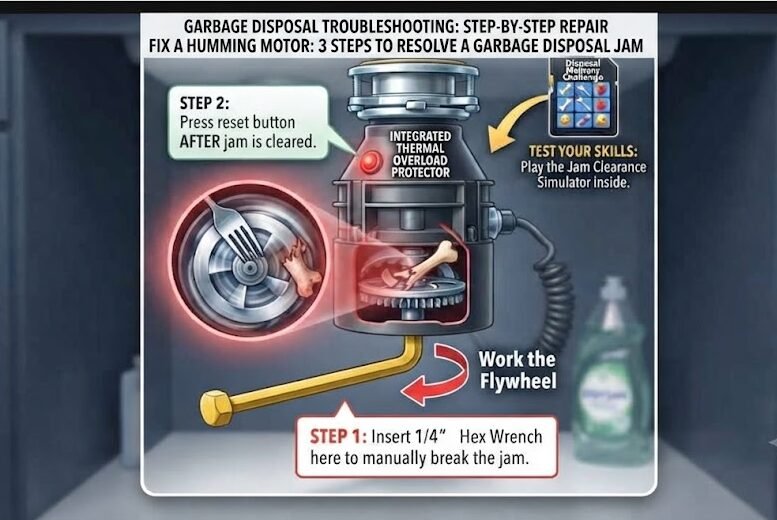
A garbage disposal jam starts the moment your kitchen sink fills with water and pressing the wall switch results only in a low-pitched electrical hum. This indicates that electrical power is reaching the motor windings, but the mechanical grinding plate is locked by debris, foreign objects, or corroded swivel impellers, triggering the internal thermal overload protection circuit to prevent motor burnout. You are facing a classic rotor lock condition, but understanding the exact mechanical trade physics behind it allows you to clear the obstruction safely in minutes, saving you hundreds of dollars in professional plumbing fees.
The Mechanical Physics of a Garbage Disposal Jam
Inside the heavy housing of your under-sink garbage disposal, a rugged steel flywheel spins rapidly at approximately 1,725 rotations per minute. Free-swinging metal blades known as impellers use powerful centrifugal force to fling food waste violently outward against a fixed, notched shredder ring, pulverizing food particles into slurry.
When a rigid foreign object—such as a fruit pit, small bone, or dropped piece of silverware—wedges tightly between the spinning flywheel plate and the outer shredder wall, or when fibrous stringy materials wrap securely around the motor shaft hub, the electric motor encounters absolute mechanical resistance. Because electrical current is still flowing into the stator windings, the motor desperately tries to turn, but the locked rotor cannot move.
If left in this state without intervention, this locked-rotor current would cause the copper windings to rapidly overheat, melt their protective insulation, and potentially spark an electrical fire. To prevent catastrophic failure, every modern garbage disposal features an integrated thermal overload protector. This internal spring-loaded mechanical circuit breaker automatically cuts electrical power the second internal winding temperature spikes past safety thresholds, resulting in the characteristic silent hum or total shutdown.
Step-by-Step Diagnostic & Recovery Protocol for a Garbage Disposal Jam
Fixing a garbage disposal jam requires zero advanced electrical skill, but it demands strict adherence to safety protocols. Follow this precise recovery procedure to clear your garbage disposal jam:
- Kill All Electrical Power: Unplug the garbage disposal cord from the wall outlet underneath your sink. If your disposal is hardwired directly into a junction box, switch off the dedicated circuit breaker on your main electrical panel. For official guidelines on residential electrical safety and appliance maintenance, consult the Consumer Product Safety Commission. Never put your hands inside the drain opening while power is connected.
- Engage the Hex Wrench (Manual Override): Look underneath the bottom center of the garbage disposal motor housing. You will find a hexagonal socket hole built directly into the base of the motor shaft. Insert a standard 1/4-inch Allen wrench (hex key) into this socket.
- Work the Flywheel Back and Forth: Apply steady leverage to the hex wrench, working it back and forth in a sweeping motion. You will encounter heavy mechanical resistance initially as the wrench forces the flywheel against the jammed debris. Continue rocking the wrench until the flywheel breaks free and spins smoothly through a complete 360-degree rotation.
- Remove the Obstruction from the Chamber: Go back to the top of the sink basin. Use long-handled kitchen tongs or pliers—never your bare fingers—to reach down through the drain flange and pull out the foreign object, bone fragment, or metal debris that caused the initial garbage disposal jam.
- Reset the Thermal Overload Switch: Locate the red or black reset button protruding from the bottom or side of the motor housing. Push firmly on this button until you feel and hear a distinct mechanical click, which re-engages the internal circuit breaker.
- Test the System Operation: Turn your kitchen faucet on full blast with cold water running. Restore power to the disposal by plugging it back in or flipping the circuit breaker, then flip the wall switch to verify that your garbage disposal jam is fully cleared and the motor hum is replaced by smooth, high-speed grinding.
Interactive Diagnostic Tool: The Kitchen Jam Clearance Simulator
Use this interactive expert memory game to test your memory and your understanding of how clearing a garbage disposal jam restores motor speed and thermal safety parameters.
Disposal Memory Challenge
🛠️ What should we break down next? Let us know your suggestions in the comments—or drop us a line directly through our Contact Page!