
If the power grid drops right now, do you know exactly how many watts to run a house safely without blowing a backup generator’s mechanical circuit breaker? Most homeowners assume a standard portable unit can automatically handle a modern household, only to find themselves sitting in a dark, freezing living room after an inductive motor spike triggers a total system shutdown.
This guide strips away the academic jargon and breaks down the exact calculations, load sequence priorities, and hidden surge requirements you need to survive an extended grid blackout with absolute confidence.
The Master Threshold: How Many Watts to Run a House Volts vs. Amps
To calculate exactly how many watts to run a house during a critical grid infrastructure failure, you must first separate basic luxury appliances from your core structural baseline survival assets.
While a completely unmonitored residential property under full modern electrical load can spike up to 15,000 to 25,000 watts, an emergency structural load profile is drastically lower. The fundamental mathematical equation governing your home’s total power consumption profile is the classic power formula:
Watts = Volts × Amps
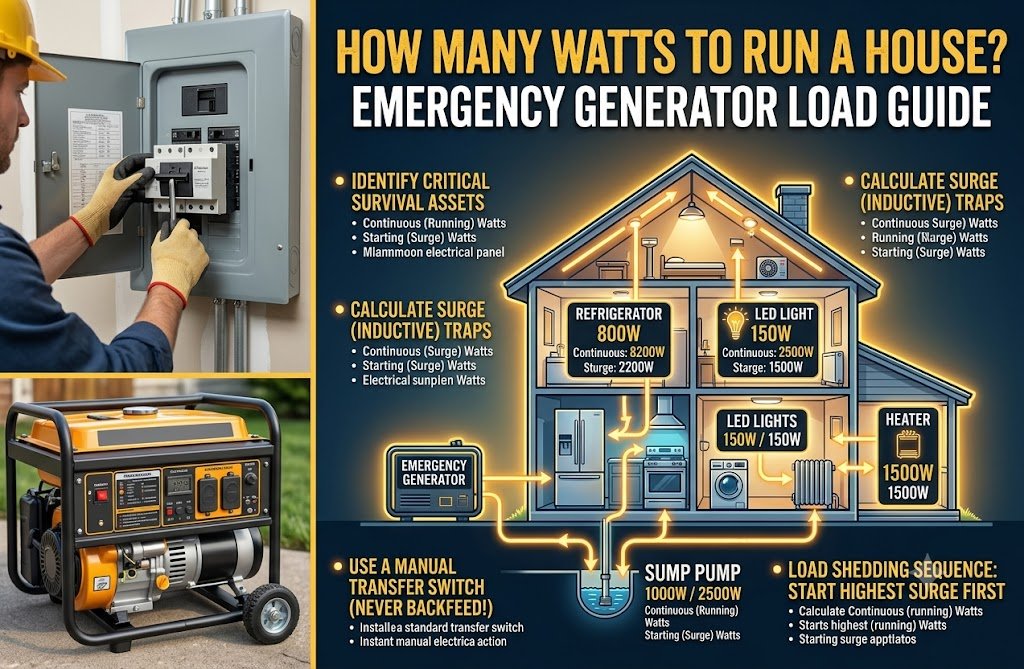
When evaluating an emergency generator setup, you are dealing with a hard limit on total instantaneous output. If you are trying to figure out how many watts to run a house, you cannot simply add up the flat numbers printed on the back of your appliances. You must evaluate the mechanical difference between Running Watts (Continuous Load) and Starting Watts (Surge/Inductive Load).
Emergency Household Power Profiles
| Appliance Asset Type | Average Running Watts | Peak Starting Watts (Surge) | Critical Survival Priority |
| Deep Freeze / Refrigerator | 800 W | 2,200 W | CRITICAL (Food Preservation) |
| Subterranean Sump Pump | 1,000 W | 2,500 W | CRITICAL (Anti-Flooding) |
| Resistive Space Heater | 1,500 W | 1,500 W | HIGH (Thermal Protection) |
| Home Router & LED Lights | 300 W | 300 W | HIGH (Communications) |
| Drip Coffee Maker | 1,000 W | 1,000 W | LOW (Morale Asset) |
The Inductive Trap: Why Your Backup Calculations Are Failing
The single biggest reason homeowners mistake how many watts to run a house is the hidden physics of inductive loads. Appliances with internal electric motors—such as your refrigerator compressor, a deep well water pump, or a basement sump pump—require a massive, instantaneous inrush of current (Locked Rotor Amps) just to break mechanical inertia and begin turning.
For instance, a standard sump pump only needs 1,000 W to keep pumping water out of your basement. However, the exact millisecond that motor turns on, it demands a massive surge of 2,500 W.
If your baseline running load is already sitting at 2,000 W on a 4,000 W generator, clicking that sump pump on will momentarily push your transient load to 4,500 W. Even though the continuous mathematics look safe on paper, your generator’s thermal breaker will trip instantly, plunging your home straight back into a cold blackout.
Purely resistive loads, like an emergency space heater or a coffee maker, do not possess compressors or motors. Their starting wattage is completely identical to their running wattage, making them far more predictable to budget, though highly demanding on overall continuous capacity.
Step-by-Step Emergency Load Shedding Sequence
To manage a limited backup power supply without destroying your equipment, you must implement a strict manual load-shedding sequence. Do not turn everything on at once. Follow this mechanical execution checklist:
- Unplug Everything First: Before starting your backup unit, turn off all structural breakers or unplug every appliance connected to the emergency circuits.
- Start the Highest Inductive Load First: Plug in your largest motor asset first (typically the sump pump or refrigerator). Allow the engine to take the starting surge spike and settle back down to its flat running wattage baseline.
- Layer Secondary Continuous Demands: Once the large compressors are humming smoothly, safely activate your low-voltage communications grid, such as your home internet router and essential LED light strings.
- Budget Luxury Cycles Dynamically: If you need to run a high-draw resistive item like a coffee maker, temporarily toggle off a non-essential asset first to ensure your total system never drifts above the maximum mechanical continuous ceiling.
🛑 Upstream Infrastructure Reminder
Never, under any circumstances, attempt to connect a portable backup generator directly to a standard wall outlet via a modified extension cord (commonly known as “backfeeding“). This creates an immediate, lethal electrocution hazard for utility lineworkers clearing down tree limbs miles away. Always utilize a dedicated, code-compliant manual transfer switch or power interlock kit installed directly into your main electrical panel.
Grid Survival Simulator Hours Survived: 0
Manage a strict 4,000W limit. Watch out for inductive motor starting spikes!
Frequently Asked Questions: Emergency Panel Math
How many watts to run a house on a portable generator?
When calculating exactly how many watts to run a house during a black-out event, a portable generator providing between 4,000 and 7,500 continuous running watts is generally sufficient to sustain standard critical household assets. This power threshold will comfortably sustain your primary kitchen refrigeration units, a water sump pump, communication routers, and localized space heating elements, provided you manually cycle heavy loads on and off.
What size generator do I need if I want to run my entire house?
If you choose not to budget your appliance power footprints and want to know how many watts to run a house under full, unrestricted operational capacity, you will need a massive whole-house standby generator rated for 15,000 to 25,000 watts. These large units switch on automatically via a permanent external fuel reserve line to handle multiple central air conditioning compressors, electric clothes dryers, and water heaters working simultaneously.
Can a 5,000 watt generator run a house safely?
A 5,000-watt generator provides plenty of capacity for a house if you limit your usage strictly to your core structural survival appliances. To determine how many watts to run a house during an outage with a 5,000W limit, you must add up your active continuous running demands (such as an 800W fridge and 1,000W sump pump) and ensure you always leave a safety margin for the heavy initial surge spikes of those electric motors.
🛠️ What should we break down next? let us know your suggestions in the comments—or drop us a line directly through our Contact Page!