
When a severe winter storm knocks out your power or you are packing your rig for an off-grid overland trip, everything hinges on your auxiliary power bank. You bought a deep-cycle battery labeled “100Ah” and assumed it would keep your essential electronics humming for days. Yet, the first time you plug in a couple of everyday appliances, your system goes pitch black in less than five hours.
Understanding how long will a 100Ah battery last is the difference between a successful off-grid run and an expensive, frozen component failure. Batteries are not perfectly efficient boxes of juice, and your household appliances are hidden energy vampires. To protect your equipment and accurately predict your system’s true resilience, you have to look past the deceptive marketing numbers on the plastic casing.
Stop guessing your power limits. If you’re ready to see how your specific appliances perform under load, skip the theory and run your numbers through the Blackout Survival Simulator below.
How Long Will a 100Ah Battery Last?
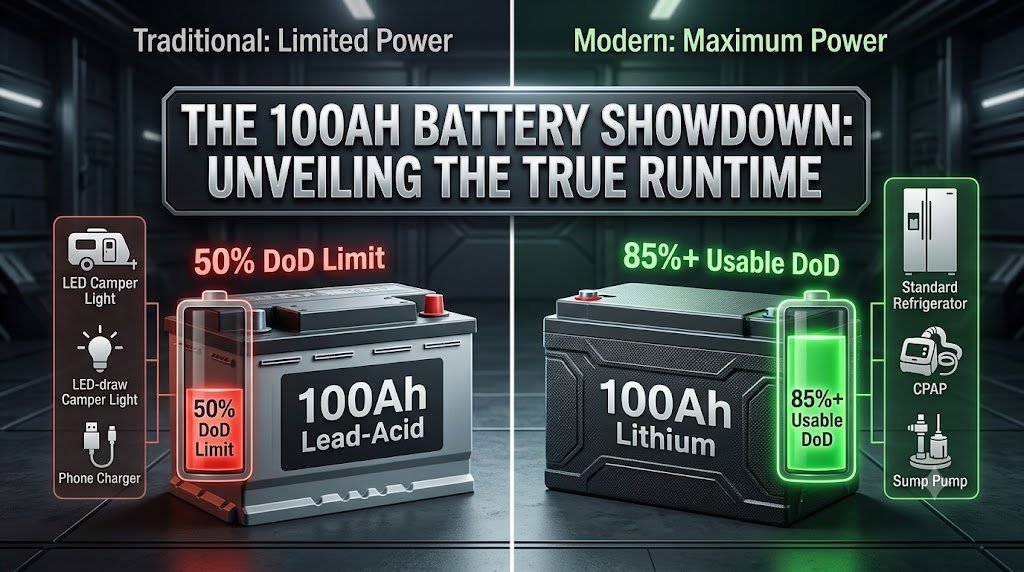
A standard 100Ah 12V Lead-Acid battery will safely run a continuous 100-watt load for approximately 5 hours, accounting for a safe 50% Depth of Discharge (DoD) threshold to prevent permanent cell damage. Conversely, a premium 100Ah 12V Lithium (LiFePO4) battery running the exact same 100-watt load will last approximately 8.5 hours, utilizing an 85% depth of discharge while accommodating a standard 15% power loss factor introduced by DC-to-AC power inverter conversion inefficiencies.
The Hidden Math: Amps, Volts, and Inverter Tax
To figure out how long will a 100Ah battery last under real-world conditions, we have to convert the battery’s chemical capacity into the mathematical language your appliances speak: Watts.
Every electrical device has a data plate listing its power consumption in watts. Your battery, however, measures its capacity in Amp-hours (Ah) at a specific voltage (usually 12 Volts). To find your baseline raw energy footprint, use the fundamental electrical power rule:
Watts = Amps x Volts
For a standard 12V 100Ah battery, the maximum theoretical energy storage is:
100Ah x 12V = 1,200 Watt-hours (Wh)
If you plug a 100-watt television directly into a 1,200Wh power source, simple arithmetic says it should run for exactly 12 hours (1200 / 100 = 12 hours). In reality, it will not come close. Two major physical constraints instantly slash that runtime: Depth of Discharge limits and Inverter Inefficiencies.
1. The Depth of Discharge (DoD) Constraint
When calculating exactly how long will a 100Ah battery last, remember that you can never safely drain a battery down to 0%. Doing so triggers immediate, irreversible internal chemical degradation.
- Traditional Lead-Acid (AGM/Gel): These cells have a strict 50% DoD limit. If you pull more than 50% of the energy out, the voltage sags below critical thresholds and ruins the internal plates. Your usable capacity is immediately cut down to 50Ah (600Wh).
- Lithium (LiFePO4): Modern lithium chemistries allow for a much deeper discharge, safely reaching an 85% to 90% DoD threshold. This yields a far superior usable capacity of 85Ah to 90Ah (1,020Wh to 1,080Wh).
2. The Inverter Tax
Your battery outputs low-voltage Direct Current (DC). Your standard household appliances require 120V Alternating Current (AC). To bridge this gap, you must run the power through a DC-to-AC inverter.
Because inverters are electronic gatekeepers that demand a toll, they significantly impact how long will a 100Ah battery last. Average consumer inverters operate at roughly 85% efficiency. This means 15% of your battery’s energy is completely wasted as heat during the conversion process.
Real-World Runtime Matrix (12V 100Ah Battery)
When analyzing how long will a 100Ah battery last, you must differentiate between low-draw DC electronics and high-draw AC appliances. The reference table below outlines exactly how common appliances deplete your energy reserves, factoring in a standard 15% inverter efficiency loss for AC items.
| Appliance / Load Profile | Average Power (Watts) | Real AGM Runtime (50% DoD) | Real Lithium Runtime (85% DoD) |
| LED Camp Lights / Phone Chargers | 15W (DC) | 40 Hours | 68 Hours |
| CPAP Medical Machine | 60W (AC) | 8.5 Hours | 14.4 Hours |
| 12V Portable Fridge/Freezer | 40W (DC / Cycling) | 15 Hours | 25.5 Hours |
| Full-Size Home Refrigerator | 150W (AC / Cycling) | 3.4 Hours | 5.7 Hours |
| Sump Pump (1/3 HP) | 400W (AC) | 1.2 Hours | 2.1 Hours |
| Microwave / Coffee Maker | 1,200W (AC) | 25 Minutes | 42 Minutes |
Peukert’s Law: The High-Draw Penalty
If you are trying to figure out how long will a 100Ah battery last when running high-draw emergency gear like a microwave, toaster oven, or space heater, your runtimes will drop even faster than the math suggests. This is due to a historical physics principle known as Peukert’s Law.
Peukert’s Law proves that the faster you discharge a lead-acid battery, the lower its overall usable capacity becomes. If you discharge a 100Ah AGM battery over a slow 20-hour window, it will happily deliver its full rated capacity. However, if you hook up a massive 1,200-watt load that forces the battery to dump its energy in under an hour, internal chemical resistance skyrockets. The battery heats up, its effective capacity plunges by up to 30%, and the system triggers a low-voltage shutdown prematurely.
Note: Lithium (LiFePO4) batteries are virtually immune to Peukert’s Law. They maintain their flat voltage curve and full capacity delivery even under intense, high-amperage current demands.
Check Your Setup: Blackout Survival Challenge
Test your energy management skills below. Toggle your essential appliances to see how long will a 100Ah battery last during an emergency winter power outage before dropping into the critical drain zone.
Blackout Survival Simulator
How to Find Your Appliance Wattage
If you aren’t sure how many watts your appliances draw, you don’t need a degree in electrical engineering to find out. Here are the three easiest ways to get an accurate number:
- Check the Data Plate: Look for a sticker or molded plastic label on the back or bottom of the device. It will usually list “Watts,” “W,” or a combination of “Volts (V) x Amps (A).” If it only shows Volts and Amps, simply multiply them together (e.g., 120V x 2A = 240W).
- Check the User Manual: The manual’s “Specifications” page almost always lists the maximum power consumption (running watts).
- Use a Plug-in Watt Meter: If you want absolute precision, you can buy a simple plug-in power monitor (like a Kill-A-Watt). Plug the device into the monitor, turn it on, and it will give you a real-time, digital readout of exactly how many watts that appliance is pulling from your system.
Frequently Asked Questions
Q: Can I mix lead-acid and lithium batteries in the same bank? A: No. You should never mix battery chemistries. Because they have different charging profiles, improper combinations will make it impossible to accurately determine how long will a 100Ah battery last, leading to premature system failure and potential safety risks.
Q: Does temperature affect how long my battery lasts? A: Absolutely. Temperature significantly dictates how long will a 100Ah battery last, especially in cold climates. Lead-acid capacity drops sharply in freezing weather, and charging lithium batteries below 32°F can cause permanent damage, drastically shortening your total usable runtime.
Q: How do I know when my battery is actually “dead”? A: A battery is “dead” when it reaches its specific Depth of Discharge limit. Relying on voltage alone is often misleading; to truly understand how long will a 100Ah battery last in your specific setup, you should use a shunt-based battery monitor that tracks real-time usage rather than just estimating based on voltage sag.
Q: Why does my inverter beep when I turn on my microwave? A: That beeping is a low-voltage alarm triggered by high-draw loads. When you pull heavy power, the voltage “sags” momentarily. If you want to know how long will a 100Ah battery last during heavy usage, you must account for this voltage drop, as the inverter will cut power to protect the battery from damage long before the chemical capacity is actually exhausted.
🛠️ What should we break down next? let us know your suggestions in the comments—or drop us a line directly through our Contact Page!