
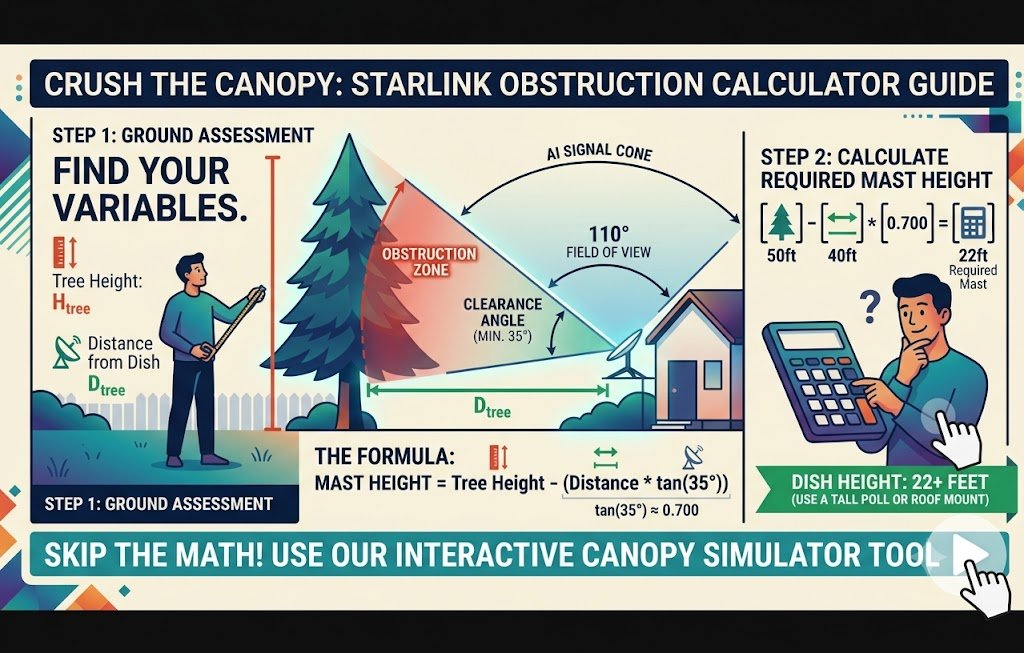
If you are trying to calculate your Starlink tree obstruction before you buy, you’ve come to the right place. Living in a rural area makes high-speed internet a challenge, especially when trees get in the way. While the official app is helpful, it requires you to already be standing exactly where the dish will go. If you need to plan for a roof mount or a 30-foot pole, you need to calculate your Starlink tree obstruction from the ground, well before you order your equipment.
This guide provides the exact math and tools you need to figure out your mast height and ensure a perfectly clear canopy.
[🕹️] Skip straight to the Clear the Canopy Simulator
Understanding the 110° Field of View
To maintain a stable connection without lag spikes or dropped packets, the standard Starlink dish requires a 110° unobstructed field of view. This means the dish isn’t just looking straight up; it looks outward at an angle.
If you are dealing with a massive 70-foot Douglas Fir on your property, the dish’s signal cone will expand outward and hit those branches unless it is mounted high enough or far enough away.
The Core Variables
To calculate your Starlink tree obstruction, you only need three measurements:
- Tree Height: How tall the obstructing tree is.
- Distance: The horizontal distance from your house to the base of the tree.
- Clearance Angle: The minimum elevation angle required by the dish (approximately 35° from the horizon).
The Obstruction Math
Instead of guessing and hoping for the best, you can use basic trigonometry to find the exact minimum height your mast needs to be to clear the tree line.
Here is the exact formula to calculate the required mast height:
• \(H_{mast}\) is the required height of your dish.
• \(H_{tree}\) is the total height of the tree.
• \(D_{tree}\) is the distance from the dish to the tree.
• \(\tan(35^\circ)\) is a constant of approximately 0.7002.
💡 Pro-Tip on Negative Results: If you plug your numbers into this formula and get a zero or a negative number, congratulations! It means your roof or ground position is already high enough to clear the obstruction zone without needing a mast at all.
If the math seems tedious, skip the calculator. Use our interactive Starlink tree obstruction simulator below to visualize your exact yard setup in real-time
Play: Clear the Canopy Simulator
Adjust the sliders below to match your yard’s dimensions. Raise your roof mast or trim the tree until the signal cone turns green!
Clear the Canopy
OBSTRUCTED: SIGNAL DROPPED
*Note: Our simulator automatically accounts for the precise 0.7002 multiplier. If your required mast height calculation results in a negative number, the simulator will show that your dish is already completely clear!
How to Estimate Tree Height
You don’t need an expensive laser rangefinder to get a reliable estimate of how tall your trees are. Here are two simple, low-tech methods:
- The “45-Degree” Method: If you are on level ground, you can use a simple protractor or your phone’s built-in level app. If you walk back until you are sighting exactly 45 degrees to the very top of the tree, the distance from your feet to the base of the tree is roughly equal to the tree’s height (just add the height of your eyes from the ground).
- The “Stick Trick”: This is a classic logging trick that requires nothing but a straight stick and a friend. (see below)
How to Estimate Tree Height (The Stick Trick)
- Stand back: Walk away from the tree until you can see the entire tree from base to top clearly.
- Sight the height: Hold a stick vertically at arm’s length. Align the bottom of the stick with the base of the tree. Keeping your arm straight, slide your thumb up until it aligns with the very top of the tree.
- Rotate: Keeping your thumb fixed at that exact spot on the stick, rotate your wrist 90 degrees so the stick is now horizontal. The bottom of the stick should remain aligned with the base of the tree.
- Mark the distance: Look at the ground where your thumb is now pointing. The distance from the base of the tree to that spot on the ground is approximately the tree’s height.
Why an Accurate Estimate Matters (And the Growth Factor)
Because the Starlink tree obstruction math relies on specific angles, being off by just 10 feet can be the difference between a crisp connection and constant packet loss.
If you aren’t sure, it is always safer to overestimate the tree height by 5 to 10 feet. Remember: trees grow! If you clear the canopy by a razor-thin margin this year, a fast-growing pine or Douglas Fir might grow right into your signal cone a couple of seasons from now. Always build a little “future-proofing buffer” into your hardware setup.
Frequently Asked Questions About Starlink Tree Obstruction
Does a small amount of Starlink tree obstruction matter?
Yes. Even a minor obstruction can lead to frequent “network outages” or “micropause” issues. Starlink’s system is highly sensitive to canopy interference. Unlike traditional satellite TV dishes that lock onto a single stationary satellite, Starlink requires a consistent, wide-angle view of the sky because it tracks a fleet of thousands of fast-moving satellites zooming overhead.
Can I ignore small branches?
It is tempting to hope the dish will “see around” thin branches or winter leaves, but our Starlink tree obstruction math assumes the worst-case scenario. If your calculations show a potential hit, it is always better to trim the tree or increase your mast height. Persistent tree obstructions mean your Zoom calls will freeze right when you are trying to speak, and your online gaming will lag out constantly.
How do I verify my setup?
Once you have performed the math and built your setup, always double-check with the official Starlink app’s “Check for Obstructions” tool. Use our calculator to plan your hardware layout before spending money on mounts, and use the app as your final, real-world confirmation.
For more details on signal propagation, you can refer to the official Starlink Support page.
🛠️ What should we break down next? let us know your suggestions in the comments—or drop us a line directly through our Contact Page!