
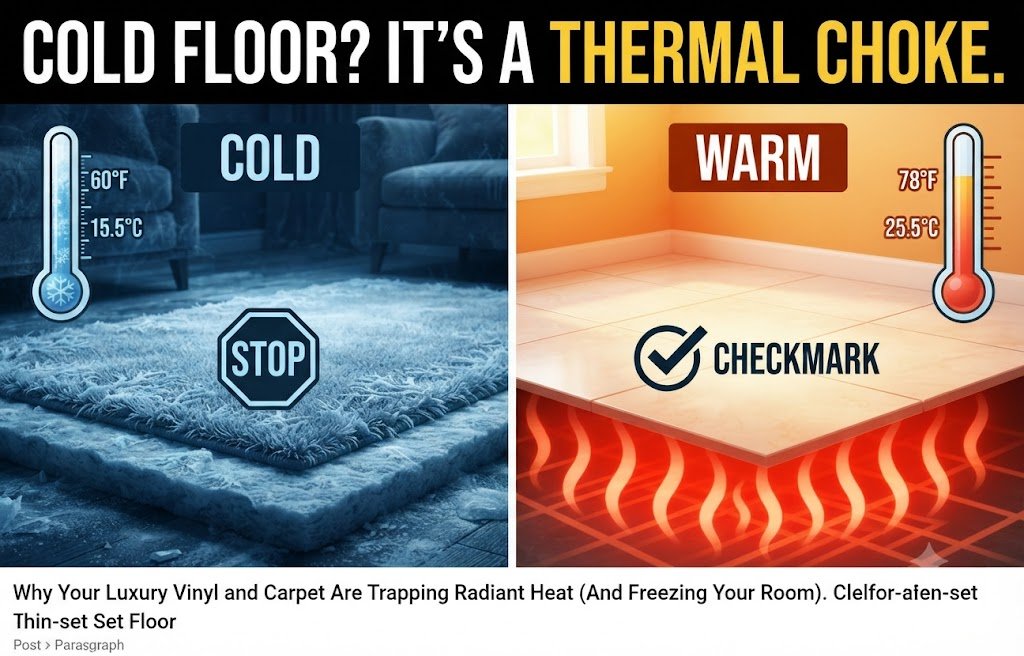
Radiant floor thermal choke issues can catch any homeowner completely off guard, but understanding the underlying thermodynamics helps you prevent expensive renovation mistakes. Homeowners invest heavily in hydronic or electric radiant floor heating, anticipating even, luxurious warmth. Yet, homeowners routinely discover that certain rooms remain stubbornly cold despite the thermostat reading maximum output. The culprit is rarely a mechanical failure of the boiler, pump, or electrical cable; it is an invisible thermal bottleneck governed by the combined thermal resistance (R-value) of your underlayment and finish flooring materials. When experiencing a severe radiant floor thermal choke, the system’s heat output becomes entirely trapped beneath the surface instead of radiating up into the living space.
Understanding this dynamic is essential before starting any flooring renovation project. Without proper planning, you can easily end up with an expensive heating layout that fails to warm your living area, leading to high utility bills and freezing floors.
The Physics of Radiant Transfer and Thermal Resistance
Radiant heating operates through a combination of thermal radiation and conduction, transferring heat upward from the subfloor assembly directly into the room. Every single material layer positioned between the heating element and your bare feet acts as a thermal resistor, slowing down the transfer of thermal energy.
- Ceramic and Porcelain Tile: R-0.10 (High conductivity, optimal heat output and rapid response times)
- Engineered Hardwood (3/8″): R-0.45 (Moderate conductivity, requires balanced temperature tuning)
- Luxury Vinyl Plank (LVP): R-0.60 to R-0.85 (High resistance depending on overall thickness, core density, and attached padding layers)
- Thick Carpet & Heavy Padding: R-1.50 to R-2.50 (Severe thermal choke, acts like an insulating blanket over your heat source)
When the total assembly R-value exceeds 1.2, the heat flux density drops below standard residential heat loss requirements (typically sitting between 20 to 30 BTU per square foot). Addressing a persistent radiant floor thermal choke requires evaluating exact material thicknesses and conductivity ratings before installation. The heating elements beneath your feet may reach their maximum design temperatures, but thick or insulating floor layers trap that heat subfloor, preventing it from ever reaching the living zone.
Common Installation Mistakes That Trigger a Radiant Floor Thermal Choke
Many DIYers and inexperienced contractors make the critical error of pairing high-output electric cables or tight hydronic tubing layouts with thick, insulating finish layers. For instance, laying down a thick acoustic underlayment foam underneath a dense luxury vinyl plank creates a double layer of thermal resistance.
Furthermore, homeowners often add area rugs over radiant floors in living rooms or bedrooms. A thick wool area rug with a rubber non-slip underpad easily adds another R-1.5 of resistance, instantly choking off heat delivery in that exact zone. If you notice cold spots directly under furniture or rugs, you are observing localized thermal choking in action.
Material Science Solutions and Practical Mitigation
To restore proper heating performance without tearing up your entire finished floor, engineers and trade professionals rely on specific mitigation strategies:
- Thin-Set Mortar Optimization: For tile installations, ensuring complete encapsulation without air pockets maximizes conductive transfer.
- Direct-Glue LVP Applications: Selecting glue-down luxury vinyl planks instead of thick floating click-lock systems reduces trapped air gaps and lowers overall thermal resistance.
- Strict Material Selection: Always verify that selected finish flooring products carry a manufacturer certification explicitly approving them for radiant subfloor applications.
Properly diagnosing and preventing a radiant floor thermal choke ensures your monthly energy bills translate into actual indoor comfort rather than wasted subterranean heat.
Stop Radiant Floor Thermal Choke With Our Interactive Tool
Before investing in expensive floor coverings or tearing up subfloors, use our interactive diagnostic tool below to calculate your specific assembly’s thermal resistance. By selecting your underlayment and finish flooring materials, you can instantly check whether your current setup risks triggering a radiant floor thermal choke before installation begins.
Radiant Floor Heat Blockage Calculator
For deeper industry reading on how subfloor materials and thermal resistance factor into efficiency standards, you can check out the comprehensive 2023 Guide to Floor Heating Systems & Radiant Heat
or review general performance mechanics via the Radiant Heating Buyer’s Guide.
Frequently Asked Questions
What is a radiant floor thermal choke?
A radiant floor thermal choke occurs when high thermal resistance (R-value) materials like thick carpet, heavy padding, or certain underlayments block heat from moving past the subfloor into your living space.
Why is my radiant floor cold even when the thermostat is high?
If your system is running at maximum capacity but the room stays cold, you are likely experiencing a radiant floor thermal choke caused by flooring materials with an R-value exceeding 1.2.
How can I prevent a radiant floor thermal choke during a remodel?
To prevent a radiant floor thermal choke, always verify manufacturer thermal ratings, avoid thick insulating carpets over hydronic tubing, and opt for direct-glue installation methods or conductive tile.
🛠️ What should we break down next? Let us know your suggestions in the comments—or drop us a line directly through our Contact Page!