
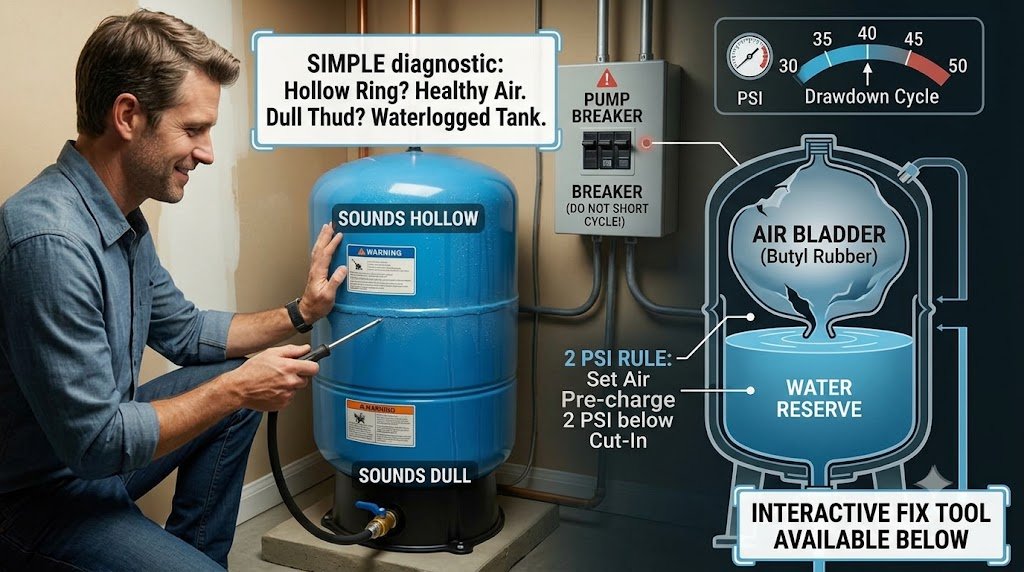
Opening the bathroom faucet only to hear a stuttering flow while a rapid, violent click-click-click-click echoes from the basement is every well owner’s nightmare. This aggressive chatter is the sound of a waterlogged pressure tank forcing your well pump motor to turn on and off every few seconds. When air cushion loss deprives your plumbing system of its natural pneumatic shock absorber, electrical surge spikes shoot through the pump motor windings. Experiencing just 30 minutes of continuous short-cycling inflicts more mechanical wear on a submersible pump than six months of normal household operation.
Understanding how a waterlogged pressure tank operates saves thousands of dollars in premature motor replacements and unnecessary emergency service calls. While home plumbing components seem complex upfront, the physical principles governing well tank pressure management rely on simple pneumatic balance. Restoring proper system operation requires recognizing early warning signs, understanding air-to-water ratios, and adjusting the Schrader valve pre-charge pressure before catastrophic bladder failure occurs.
What Causes a Waterlogged Pressure Tank?
A waterlogged pressure tank occurs when the vital cushion of compressed air inside the steel vessel escapes or becomes absorbed, leaving the tank filled almost entirely with non-compressible water. Water cannot be compressed under standard domestic pressures. Without an adequate volume of trapped air to absorb hydraulic pressure spikes, opening a faucet causes system pressure to drop instantaneously below the cut-in threshold of the pressure switch.
Under ideal conditions, the internal rubber diaphragm or butyl bladder maintains a strict separation between standing well water and the pressurized air envelope. Over years of thermal cycling and expansion, rubber membranes experience mechanical fatigue, micro-perforations, or full tears. When the bladder ruptures, air bleeds out through the water supply, turning the waterlogged pressure tank into a solid column of water. Even in bladderless steel tanks, air naturally dissolves into standing water over time, requiring periodic manual replenishment to prevent severe short-cycling.
3 Critical Warning Signs of Well Tank Air Cushion Loss
Identifying a waterlogged pressure tank before motor winding insulation melts down requires monitoring three distinct physical symptoms:
- Rapid Pressure Switch Short-Cycling: The most immediate indicator is the electro-mechanical switch rapidly clicking on and off whenever water is running. If the pressure gauge needle bounces wildly between 30 PSI and 50 PSI within seconds, the system lacks pneumatic cushion.
- Sputtering Faucets & Water Pressure Fluctuations: Because there is no compressed air buffer maintaining steady line velocity, water flow at household fixtures surges and fades violently in sync with the pump motor cycling.
- The Solid “Thud” Sound Test: Tapping the exterior steel shell of a healthy tank with a screwdriver handle yields a hollow ring across the top 60% (where air lives) and a dull thud near the bottom. A fully waterlogged pressure tank produces a heavy, dull thud from top to bottom due to total water displacement.
The Physics of Drawdown & The 2 PSI Rule
The operation of every residential well system relies on Boyle’s Law (P1 × V1 = P2 × V2), which establishes that gas pressure and volume are inversely proportional at a constant temperature. When your well pump runs, it forces water into the tank, compressing the air pocket into a smaller volume (V2) and elevating air pressure to the cut-out limit (P2, typically 50 or 60 PSI). Turning on a fixture allows the compressed air cushion to expand (V1), smoothly pushing water out through household pipes until pressure drops to the cut-in point (P1, typically 30 or 40 PSI)
+-------------------------------------------------------+
|              HEALTHY TANK (Air Envelope)              |
|  [ Compressed Air Pocket ]  --> Acts as Shock Absorber|
|  =========================  (Flexible Diaphragm)      |
|  [ Water Reserve Volume  ]  --> Smooth Flow Control   |
+-------------------------------------------------------+
|             WATERLOGGED TANK (Air Escaped)            |
|  [ Solid Standing Water  ]  --> Non-Compressible      |
|  [ Solid Standing Water  ]  --> Instant Spike/Drop    |
+-------------------------------------------------------+
To maintain optimal drawdown volume and protect the internal diaphragm, the air pre-charge inside an empty tank must be calibrated using The 2 PSI Rule:
Required Air Pre-Charge (PSI) = Pressure Switch Cut-In (PSI) – 2
For example, a standard 30/50 PSI pressure switch setting requires the empty tank’s top Schrader valve to be pressurized to exactly 28 PSI. If set higher than the cut-in pressure, the bladder collapses completely before triggering the pump, causing a sudden loss of flow. If set significantly lower, the waterlogged pressure tank becomes partially flooded under normal resting conditions, reducing usable drawdown capacit
How to Fix a Waterlogged Pressure Tank (Air Reset Procedure)
If the internal rubber bladder remains intact and has merely lost air over time, you can restore full pneumatic capacity using standard household tools:
- Isolate Power: Flip the dedicated double-pole breaker supplying power to the well pump motor to prevent dry-running or unexpected startup.
- Drain Water Capacity Completely: Attach a garden hose to the tank drain valve at the base and open a low-level faucet to relieve all hydraulic line pressure until water stops flowing entirely.
- Check Schrader Valve Stem: Remove the protective cap on the top of the tank. Depress the central pin briefly. If water spurts out of the air valve, the internal bladder is ruptured and the entire pressure tank must be replaced. If only air or nothing escapes, the bladder is intact.
- Recharge Air Cushion: Keep the tank drain valve open so displaced water can escape. Connect a bicycle pump or portable air compressor to the Schrader valve and inflate until air pressure reaches 2 PSI below cut-in (28 PSI for 30/50 systems; 38 PSI for 40/60 systems).
- Restore System Operation: Close the drain valve, turn the electrical breaker back on, and monitor the pump through one complete cut-in to cut-out cycle to verify steady operation.
Interactive Tool: Diagnose Your System & Calculate Air Pre-Charge
Before you disconnect your plumbing or call an expensive well technician, run your system parameters through our Well Tank Air Pre-Charge & Drawdown Calculator below.
By inputting your tank’s nominal size, pressure switch cutoff settings, and current pressure gauge reading, this diagnostic tool will instantly calculate:
- Your exact required Schrader valve PSI pre-charge based on The 2 PSI Rule.
- Your true usable drawdown capacity in gallons before the well pump engages.
- Your current air cushion status, flagging critical short-cycling risks and potential bladder failure before motor damage occurs.
🛠️ What should we break down next? let us know your suggestions in the comments—or drop us a line directly through our Contact Page!