
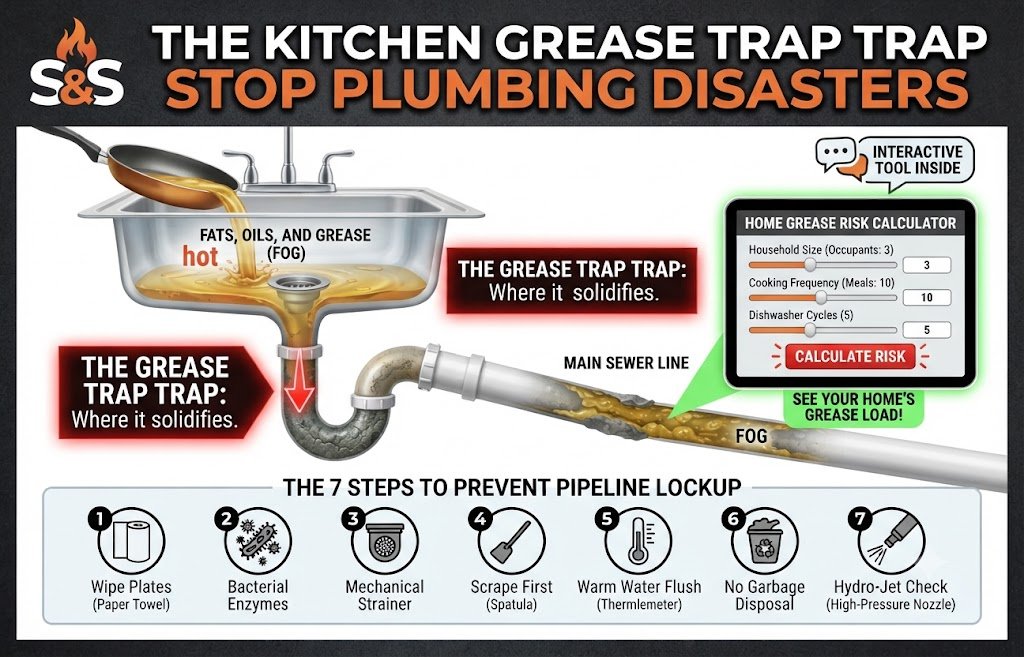
If your kitchen sink smells like a decomposing rendering plant and drains like cold molasses, your sanitary line isn’t just clogged—your residential grease trap has likely solidified into industrial soapstone. Effective grease trap cleaning is the single most important maintenance task homeowners ignore until it’s too late.
When homeowners experience a slow-running kitchen drain, the universal reflex is to grab a bottle of commercial chemical drain cleaner or a plunger. Unfortunately, while harsh caustics temporarily punch a tiny hole through congealed fats, they fail to address the root cause of residential plumbing failures: un-emulsified fats, oils, and grease (FOG) cooling inside your drain lines and hardening against pipe walls. Mastering routine grease trap cleaning and understanding the science of grease accumulation is the only permanent way to protect your home’s wastewater infrastructure.
The Anatomy of a Kitchen Grease Blockage and Why Routine Grease Trap Cleaning Matters
Fats, oils, and grease entering a kitchen sink might look harmlessly liquid when hot, but they undergo rapid phase separation and solidification the moment they hit the ambient temperature of underground or interior drain pipes. Without regular grease trap cleaning, clogs inevitably form.
- The Saponification Trap: As animal fats mix with mineral-rich hard water and alkaline dish soaps inside your drainage system, they undergo saponification—a chemical reaction that turns ordinary grease into a hard, insoluble metallic soap that demands physical grease trap cleaning.
- Thermal Drop-Off: Residential drain pipes typically maintain a temperature between 55°F and 70°F depending on crawl space or slab placement. Animal fats often solidify at anywhere from 90°F to 110°F, meaning cooling happens mere feet from your garbage disposal.
- The Layering Effect: Each time greasy water is run down the drain without proper grease trap cleaning, a new microscopically thin layer coats the pipe interior, progressively shrinking the pipe’s inner diameter until a total blockage occurs.
Calculate Your Home’s Grease Trap Risk
Stop guessing when your sanitary line will fail. Input your household cooking and dishwashing parameters below to calculate your exact weekly grease volume and required bacterial enzyme maintenance schedule for optimal grease trap cleaning:
FOG Accumulation & Enzyme Dosage Calculator
Calculate your household daily grease output and required bacterial treatment intervals.
The 7-Step Protocol to Prevent Pipeline Lockup
- Never Trust Boiling Water Alone: Pouring boiling water down a greasy drain only melts FOG temporarily. As soon as the water travels 15 feet down the line and cools down, the grease resolidifies in a thicker, wider choke-ring further away. Always wipe pots down with paper towels before washing.
- Deploy Specialized Bacterial Inoculants: Traditional chemical cleaners scorch pipe walls and kill helpful septic balances. Instead, utilize bacterial enzyme treatments containing Bacillus strains that specifically target long-chain fatty acids, digesting them into carbon dioxide and water as a core component of your routine.
- Install Mechanical Strainers and Interceptors: For high-volume cooking households, introducing a mini under-sink grease interceptor creates a physical baffle chamber where cooling oils float to the surface while clear wastewater exits below.
- Enforce the Scraping Rule Before Washing: Never run un-scraped plates or pans directly into a sink or dishwasher. Dry-wiping plates with a silicone spatula or paper towel captures up to 90% of free-floating fats before they ever touch wastewater.
- Incorporate Monthly Hot-Water Enzyme Flushes: Combine your biological enzyme treatments with a controlled, warm-water flush (around 105°F—never boiling) to activate bacterial colonies without re-liquefying and pushing sheets of heavy grease downstream.
- Eliminate Garbage Disposal Grease Abuse: Operating a garbage disposal while washing down greasy food scraps creates a high-surface-area pulp that binds fats together into an indestructible, cement-like slurry. Keep food waste out of disposal drains entirely if cooking oil is present.
- Schedule Professional Hydro-Jet Validation: Once a year, use specialized high-pressure municipal-grade jetting or inspection cameras on your main sewer line to scour pipe walls clean and strip away years of invisible micro-layering before a total blockage occurs.
🛠️ What should we break down next? let us know your suggestions in the comments—or drop us a line directly through our Contact Page!